zondag 29 april 2012

K3WW with 100000 Miles per Watt

When I went into the ARRL international DX contest, the first station that I heard was K3WW. K3WW is a station with Excellent Ears.
The signal of Charles was stronger than the usual S8.
The signal was over S9, so I decided to try a lower power than the usual 360 mW and I switched to 36 mW, using a 10 dB attenuator. I expected that I had to use more power, but to my surprise we made the QSO with just 36 mW in CW, using an Inverted Vee.
My FT-817 only gives 360 mW instead of 500 mW after a serious mismatch, but I still have great fun with low power and 1000 MPW.


The distance between my QTH JO22na and K3WW in FN20ii is 3725 miles.
With 36 milliwatts this gives 103000 Miles per Watt.
Thank you Charles for the fine QSO. Hpe cuagn in the next contest.


CQMM DX 2012

I just sent in my Cabrillo file for the CQMM DX contest. I had some trouble to make the entry. I logged on paper and made a Cabrillo file in Excel. But the robot refused my entry based on version 2. So I used an online webform to make the Cabrillo file in version 3.

We were invited out for a birthday, so I only had time on Saturday and only made one QSO before we left on Sunday. I used the Lowest Possible Power in each QSO.
I started, late around 19:45 local time, so the propagation to Europe was good. At first I made some more than 1000 Miles per Watt QSO's in Europe. About one hour later the signals from North and South America came through.
The signal of N2MM was stronger than S9. Carol was S8 through the 10 dB attenuator, so the QSO could be made with 80 mW. The exchange was 599 NAY . The Y means YL.  Later AA3B was also worked with 80 mW.
It is years ago that I met AA3B with just less than 100 mW, so you don't hear me complaining about the propagation. hi.


This CQMM DX contest brought 3 new DXCC's: FM, OX and CE.  
Martinique with 360 mW, gives a very nice QRPp more than 1000 Miles per Watt QSO.


This survey, showing the bands is also interesting. To North America was slightly less power needed at 15 m than on 20 m. Notice that the difference between 80 mW and 360 mW is just ONE S-point. 4x is 6 dB is one S-point.
By comparing the info in both tables, you can find out, on what band each DXCC was worked.
21 out of 28 QSO's were more than 1000 Miles per Watt QSO's. This is a staggering 75%.

zondag 22 april 2012

Still using the Internet Explorer

Blogger has changed the navigation to make a new Blog entry. They changed it in a way that the Internet Explorer is NOT working.
I have used the Google browser Chrome for a while. But  the Chrome cuts and pastes differently from Internet Explorer giving problems with in copying and pasting of tables and data from lists, like the WSPR database. So I already went back to the Internet Explorer.
Now I must use the Google browser, if I want to make a new Blog entry.
So Chrome is still installed, but for all internet surfing I only use the Internet Explorer.

Stange things

Sudenly my standard browser is not good enymore for Blogger. So I can not place my new entry about the first results of the CQMM DX contest.

dinsdag 17 april 2012

CQMM DX coming up this weekend


The CQMM DX is a very special contest for QRP sytations.
A QRP station is recognized by it's exchange. E.g. SAQ meaning South America QRP. So as a QRP station you immediately known, that the QSO is a 2 way QRP QSO, when you receive such an exchange.

Last year I had great fun in the CQMM DX contest. Look at this Blog entry of 2011.

In the CQMM DX contest of 2011, I was surprised by the excellent propagation, which made it possible to work with stations in South America and North America with just 1 W or 2.5 W.

Next weekend there will be much activity from South America, so join the fun in the CQMM DX in which you can work every station.

Click for the CQMM DX website or Rules 2012

donderdag 12 april 2012

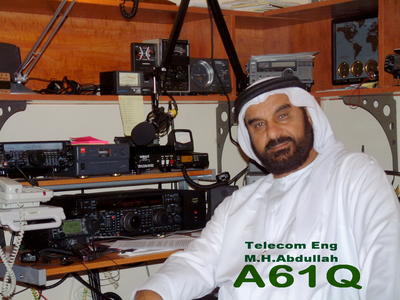
A61Q United Arab Emirates

After reading about disappointing conditions in other Blogs, I did not expect, to make any QSO's today. But I went to 18 MHz and I did heard EV1R. At first I wanted to use 2.7 W, but then I realized that the signal was rather strong, so I used 360 mW. With 360 mW and 941 miles this QSO is good for 2613 Miles per Watt. hi
After this QSO I stayed on 18 MHz and made a QSO with EA5AR using 2.7 W. Ric gave 549 with QSB.

United Arab Emirates
Then I heard A61Q calling CQ DX on 15 m. With a distance of just more than 3000 miles, according QRZ, I choose a power of 2.7 W.

Now several stations were answering and at first I mingled with these other stations, but without success. With 2.7 Watts, I am not the "Pile up King", so I decided to wait for the right moment to give my call and in the mean time I listened to the mode of operation. This payed off, much sooner than I expected.
For me the United Arab Emirates (A6) is a new DXCC in QRP. With 2.7 W and 3189 miles this FB QSO is good for 1181 Miles per Watt. hi
Thanks to A61Q with his excellent ears

I just found that A61Q uses eQSL. So I will send an eQSL. hi

zondag 25 maart 2012

Russian DX 2012

Last week I participated in the Russian DX contest. One of the support wires of the inverted vee was broken, so the wire ran from the top of the mast to the raingutter and then vertically along the house to one meter above the ground. Still I made QSO's with very low power.


The conditions on 14 MHz were good, so I used to lowest possible power.
On 7 MHz I had to use the maximum power of 2.7 watts in all QSO's.
The most remarkable QSO was made with PW7T with a power of 2.7 watts.
The numbers in red are indicating more than 1000 Miles/Watt QSO's.

zondag 4 maart 2012

UBA DX CW Contest (2)

In most contests, I use the lowest possible power in each QSO.
Also in this contest I started with search and pounce with low power.
But because a station from the Netherlands is a wanted station in this contest, I also tried to called CQ myself, using 2.7 W.
Very occasionally I was heard by more than one station, who would than call at the same time. But on other moments my QSO-rate dropped, when I called CQ. So then I would go back to S&P after a few QSO's.

QSO-rate
I calculated that I made one QSO in two or three minutes, while searching on the band, answering stations that are calling CQ.
When not too many other stations are also answering, I don't have to wait long to make a low power QSO.
I tent to answer, with more power than needed, when I have to wait for a longer time.

The bands
14 and 21 MHz were good. On 14 MHz the lowest power was used.
On 14 MHz 80% of the QSO's were made with QRPp and on 21 MHz only 50%.


When the S-meter goes up, the power goes down.

zondag 26 februari 2012

UBA DX CW contest

The UBA DX CW contest is a very nice contest. Such a DX contest gives the opportunity to work everyone. On Saturday I used the lowest possible power in each QSO. On Sunday I also gave CQ my self in a few QSO's. I worked mainly station from Europe. The antenna is an Inverted Vee.

UBA DX 2012 - PA1B
The table shows the worked DXCC's. The numbers in red are more than 1000 MPW QSO's. After a quick count I realized, that I made much more 1000 Miles per Watts QSO's, than I expected.
45 QSO's out of 72 is 63%

vrijdag 24 februari 2012

ARRL International DX contest 2012

I really took it very easy in this contest. I used to have great fun with QRP, but this year I spent limited time in the contest. I worked 9 different states in 12 QSO in CW with QRP.
With a power of 2.7 watts or less, all the QSO's are good for 1000 Miles per Watt. hi

zondag 19 februari 2012

QRPp How is it possible

When I started as a HAM, 20 years ago, I used my homebrew transceiver HM7, from Solid State Design, page 214...218, with an Inverted Vee, to work many different DXCC countries in Europe in CW. Because my power was only 500 mW, I had to look for stations, that I received with 599 or more, so the other station could hear my QRPp signal of 500 mW.
During daylight hours my RST would be 559, or even lower.
Please notice that a power of 500 mW is only four S-points weaker than 100 Watts.
See the PA1B QRPp page.

D and E layer
The radio wave is not attenuated when it is reflected by the E-layer. (Total reflection) But during daytime the signal is attenuated by the D-layer, when it passes through the D-layer.
During daylight hours, the signals are attenuated by the D-layer, which is absorbing

I discovered, that when darkness fell, the signals from the south of Europe would be very loud. So this made it easy, to make QSO's over a distance of 1000 km or more. When the D-layer disappears during the night, the signal can reach the the E-layer without attenuation in the D-layer.

The E-layer reflects the signal without attenuation

When the D-layer disappears, there is no attenuation in the radio path. The signal is reflected by the E-layer without attenuation. The attenuation of this sky wave is (only) 6 dB for a doubling of the distance. So the signal will be very strong.
At first, I did not realize, that my own QRPp signal, could also be an earsplitting 599, until I got genuine report from Italy, that my signal was S9, while using just 500 mW.

How low can you go
I was wondering, what the lowest possible power would be, if I would reduce my power in that situation with this excellent propagation.


If I reduced my power, so my RST would be 559, the difference is 4 S-point. This is a reduction in power of 4 x 6 dB = 24 dB which is 4 x 4 x 4 x 4 = 256.
So I could reduce the the power from 500 mW to about 2 milliwatts.

I was surprised by the low value, that I calculated, but this value is very realistic.
From 2001 on, I made many CW contest QSO's over more than 1000 Miles with 2.5 mW and 5 mW,
using PA1B homebrew attenuators.

I discovered that the frequency must be absolutely clear, when you use very low power.

vrijdag 17 februari 2012

Power in Cabrillo file in the ARRL int DX contest

I very much like the ARRL international DX contest. In this contest, the DX stations like myself, will give their power in the exchange. This is great for a QRP station, because my power is directly visible to the other station.

QRP
In my first ARRL international DX contest, I used 5 watts. My exchange 599 005 gave no problem for the receiving station. It was obvious, that I was using QRP.

As a milliwatt and low power enthusiast, I often use the Lowest Possible Power, in each QSO. When I hear a station calling CQ, I look on the S-meter to determine the power with which I will answer.
The higher the S-meter reading, the lower my power can be.
When using the lowest possible power, I do not call CQ myself.

In later years, I reduced to 500 mW. The use of 500 mW in a QSO was no problem, because I will often get an immediately correct response, but the problem was my exchange. How to indicated, that I was using only 500 mW.

599 001
Over the years, I found out, that when I was using 500 mW, I best could use the exchange 599 001. The value 001 is the lowest value, that can used in a Cabrillo Log.

Pwr?
But don't think that all problems are gone with 599 001. Some stations keep asking pwr?, because they think thay 001 is a number or they respond with 100? or even 1kW?. In that case I will respond with "599 1W 1W".

* I met operators, that fall out of their chair, when they realized, that my exchange 599 001 indicated, that I was using only 1 watt.
One second of silence and an additional "1W FB", from a station that is transmitting not a letter to many, I consider as a huge compliment. hi

* Please notice that when you use low power, that any QSO between Canada or the USA with Europe with 3 Watts or less, is good for 1000 Miles per Watt.

zondag 12 februari 2012

PACC 2012

Sinds eind december ben ik niet meer actief geweest in contesten.
Ik had eigelijk niet zo'n zin in de PACC en het was maar de vraag of ik wel tijd zou hebben vanwege andere bezigheden. Toen de PACC gestart was, wandelde ik nog heerlijk in Amelisweerd. Ik was daar al in maanden niet meer geweest en het lekker weer was, om te wandelen. Om 12:33 utc logde ik dit reigertje.

Op zaterdag heb ik hoofdzakelijk CQ roepende stations geantwoord. Op zondag morgen heb ik in het laatse uur van de contest 37 QSO's gemaakt door zelf CQ te geven. Dat is meer alle QSO's op zaterdag. In totaal maakte ik 64 QSO's

Since the end of december I have not been active in contests.
I did not feel like participating in the PACC and it was to be seen, whether I could find time because of things, that had to be done in this weekend. When the PACC started, I still enjoy a walk in Amelisweerd. I had not been there in months, and it was nice weather for a walk. At 12:33 utc I logged this "reigertje". (small heron)

On Saturday I mainly replied stations calling CQ. On Sunday morning, in the last hour of the contest I made 37 QSOs while giving CQ. That is all the more QSOs on Saturday. The total number of QSO's is 64.


Kromme Rijn bij Rijnauwen

woensdag 8 februari 2012

Parasaki

Yesterday I received the schematic of a very remarkable transceiver in an e-mail from Peter DL3PB.
The Parasaki transceiver is an all diode receiver which is built with tunnel diodes in stead of the usual transistors. Peter proudly said, that a long cherished dream came true, after 40 years, to build and operate a transceiver build with tunnel diodes.

But that's not all. After completing his temporary antenna, Peter heard the very, very strong signal of Christophe F8DZY, in the France REF contest. When Peter answered his CQ, he got an immediately correct response, although his power was only 2 milliwatts. hi

Parasaki Transceiver Power 2 milliWatt  Peter  DL3PB
This is what Peter wrote in his first e-mail:

Hi folks,

I'd like to share with you a long-cherished dream, that recently came true, fourty years after I came to read about hams using tunneldiodes to make QSOs when I was aged twelve or so:
Finally I managed a first skywave QSO with my PARASAKI-transceiver, an 'all diode' rig:
Christophe F8DZY replied to my very first call on 20m band in REF-contest last weekend.
I was running 2mW into a temporary vertical dipole on my balcony. Distance between us is 918km - obviously OM Christophe has excellent ears.
Those interested in the cruel details of my circuit, please find attached a schematic and a photo of the pretty ugly setup. The circuit is designed straight-forward with exception of the parametric VXO, derived from Mike/AA1TJ's famous Paraceiver design. (see http://fhs-consulting.com/aa1tj/paraceiver.html )
The low impedance of the high peak-current tunneldiodes make it very difficult to built a really crystal controlled oscillator rather than an LC-oscillator, synchronized by the crystal more or less, at least on the higher SW-bands. The Parametric VXO provides a crystal-stable, chirp-free signal on expense of an output power of two milliwatts only instead of ten, but with an amazing spectral purity, no need for a low pass filter or such.
Of course it sounds pretty cool making a QSO with a 'bunch of diodes' and a parametrically excited crystal, but believe me or not, I'd preferred to bring that full ten milliwatt into the air - on the other hand that approach allowed to tune the rig a bit ( ~ 5kHz/per xtal ), which turned out to be much more valuable than a few milliwatts more while being 'rock-bound'.
The receiver in its 'gain-less' version works fine for strong signals - while listening to QRP(p) stations, the moderate gain of the audio amplifier helps a lot. A comfortable frequency shift between receive and transmit is realized by the 5µH inductor at the LO-port of the mixer, with little effect on sensitivity.
Thanks for the bandwidth, OMs, won't bother again you with such mails, unless I make a cross-pond QSO with that rig ( not that likely ) or any skywave QSO with homemade semiconductors ( probably impossible )...
72! Peter/DL3PB


In my answering e-mail I said:

As a milliwatt enthusiast my self, I know the thrill of making contest QSO's with a few milliwatts. Your 2 mW reminds me of the QSO's, I made in 2001 to 2003 with 2.5 mW to 10 milliwatts in many different contests.
It is amazing what a "simple" circuit like this can do. I like the set up on these experimenting board. It's great fun. I think you made an excellent choice to choose for "broader" tuning range. But "on the edge" a few dB can really be helpfull. hi
Yes, Christophe must have excellent ears. But with so little amplification in your receiver, you also must have excellent ears.


The next day Peter replayed with:

Hello Bert,
when I actually had set up my antenna last saturday and while adjusting my rig,
I heard F8DZY call CQ test - he was really booming in, and I recalled your strategy, to monitor the signal strength of the incoming signal in order to find the best time for a call.
I have no S-meter, but he was peaking such, that I was sure that couldn't last for long - so decided I'd better give him a call immediately rather than trying to squeeze the last tenth of milliwatt out of my rig - so I did and before I could repeat my call once more, he came back with my callsign and the department number - so it payed off to study your miliwatting results carefully!
Sensitivity of the receiver is not that bad, given the low part count - with the audio amp and a sound powered' headphone I can copy EU-QRP stations pretty good. Of course that won't work with a TV playing in the background, but I'm blessed with a wife, who is willing to use headphones on occasion.
Thanks a lot, Bert, please keep up your great blog!
Peter/DL3PB


Congrats Peter, on your great achievement!

Click here to go to Roger G3XBM's Amateur Radio Blog for
more info on the Parasaki transceiver.

Click here to go to SolderSmoke Daily News for
more info on the Parasaki transceiver.

zondag 8 januari 2012

QSL Cards

In the last two weeks I have written more than 200 QSL cards. Mostly for more than 1000 Miles per Watt QSO's. Yesterday I brought a pile of 7 cm (2.75") to the QSL manager.

I still send paper QSL's for nearly each 1000 MPW QSO's, so the HAM that I worked with very low power, can read all the info on my card.
To calculate the distance and Miles per Watt, I always look up the QTH-locator on QRZ.

I noticed that more and more stations use LotW or will send the card only direct for $2. So now I also use QRZ, to look, if the station will answer a QSL via the bureau or eQSL.