Posts tonen met het label Attenuator. Alle posts tonen

dinsdag 6 januari 2026

43 dB Attenuator built by Kees PE0CWK

Kees PE0CWK
Kees PE0CWK
I met Kees PE0CWK on a meeting of the Benelux QRP Club in Harderwijk. 

He has successfully built the PA1B 43 dB Attenuator.

When Kees showed me his 43 dB attenuator, I took a few pictures.

Kees tolt me that attenuator works great and is very pleased with the attenuator.

I made photo's of Kees and his attenuator.


43 dB Attenuator built by Kees PE0CWK

Step Attenuator
The PA1B 43 dB step attenuator is a very accurate attenuator.
Built with good available resistors from the E12-series.
The attenuator is built with carbon resistor of 2 W and 400 mW.

Schematic
Visit the Webpage with the:  PA1B 43 dB Very Accurate Attenuator

PA1B 43 dB Very Accurate Attenuator


woensdag 27 juni 2018

36 dB Attenuator of PA2ZZ

I received an email of Henk  PA2ZZ. He has successfully built the 36 dB attenuator. Henk wrote that attenuator works great. He uses the attenuator for WSPR with his K3 and a MFJ-loop.
I asked Henk for photo's of the attenuator.
Here they are.

36 dB Attenuator built by Henk PA2ZZ

The Attenuator 20 dB - 10 dB  - 3 dB - 3 dB of Henk PA2ZZ

The Attenuator 20 dB - 10 dB  - 3 dB - 3 dB
Thank you, dear Henk for the beautiful pictures.

donderdag 19 januari 2017

Attenuator for the FT-817 by G4EFE

On my Blog post about the Power attenuator for the FT-817, that I published in SPRAT, I got a very nice comment from Martin G4EFE.

Martin writes:
Hi Bert - I just built this into a tiny 25x25x50mm metal enclosure. Of course, it works great.
Looking forward to some QRPp WSPR from the IC703.

Attenuator built by Martin - G4EFE
As you can see, the attenuator is built in a beautiful, small enclosure.

Power
The maximum power of the attenuator is about 1.5 W. With a derating of 33% the nominal power of the attenuator is 500 mW. I advice to use the lowest power setting of the transceiver. For my FT-817 this is  500 mW.
Martin will use a IC703. This transceiver can make 100 mW at it lowest setting.

Thank you Martin for sharing the info and good luck in QRPp.

donderdag 29 september 2016

40 dB attenuator built by DK5LH

40 dB attenuator built by DK5LH
Click to enlarge  
I received a very interesting email from Hartmut DK5LH, in which he informed me that he successfully built the
PA1B  40 dB attenuator.    Click for schematic
He is very pleased with the excellent accuracy of the attenuator, that makes this attenuator suitable for measuring purposes.

Hartmut uses the attenuator to measure the power of his transmitter (2 watts) with a power meter for -80 dBm to -10 dBm
The attenuator is used to reduce the output power of the set to a value that is less than 0.1 milliwatt. (-10 dBm)


40 dB attenuator with metal film resistors of  2 watt and 600 mW  -  DK5LH  
Resistors
Hartmut has used resistors, that he ordered at the firm Reichelt.   Resistors 2 watts.
In his email Hartmut writes:
Ich habe diese widerstände nicht ausgemessen, sondern einfach so genommen. 
Offensichtlich sind dieses sehr genau
which means:
I did not measure the resistors, but just used them. 
Obviously  they are very accurate.

Accuracy
The attenuator is built with good available metal film resistors from the E12-series, with an accuracy of  5%. It shows an  excellent accuracy, because in practice the resistors show a accuracy of 1.5 %, or better.
The picture below shows the excellent accuracy of each of the four attenuator sections.


Hartmut is very pleased with the excellent accuracy of his 40 dB attenuator. His attenuator shows an attenuation of 40,5 dB, with the maximum attenuation, with all sections switched to ON. He has calculated the attenuation with the method of measuring DC voltages.

Thank you, dear Hartmut for emailing the beautiful pictures and additional info.
It's my pleasure to show your beautifully built attenuator.

dinsdag 26 juli 2016

Stefano IZ1OQU makes SSB QSO's with 5 mW

Stefano IZ1OQU 5 mW SSB
with light weight VHFantenne
Hi Bert,
One year passed since our last email and now I write to tell you some recent news about my experiences with power attenuators in QRPp.
Last Sunday, during the Italian Apulia Contest VHF on 2 meters, I made 19 QSO's.
11 QSO's were completed with 5 mW, 4 with 50 mW and 4 with 500 mW. 
I never needed to repeat my callsign. No propagation, no e-sporadic: just directs. 
The best QSO was with a French station over 312 km, good for 62.400 kms per watt
My operating location was 500 m asl, with good opening to the sea and the French coast. I'm forgetting to say... That it was SSB!

The antenna is a personal design, low weight very easy to use on portable: two rectangles vertically linked to each other, with nice gain and good front/side. You can see it on my qrz.com. But I attach a photo for your comfort.

What an unbelievable experience! The first time with 5 mW drove me crazy. Surely VHF offers big chances to play with micro-powers, thank to big-gain antennas both on tx and rx sides, and global low power absorption. It is a test that I want to repeat as soon as possible, looking for DX.

Every time I think back to the day that I found your website: my life changed and my passion for QRPp now flies on golden wings. Thank you again, my friend.

Best regards
'73 de IZ1OQU Stefano

zondag 26 juni 2016

PA1B Attenuator

I developed attenuators that very accurate and fast to operate. In order to get the best power distribution, the attenuator section with the lowest attenuation is placed in front. I use these attenuators in very low power CW QSO's.

PA1B Fast and accurate power attenuator for CW QSO's
Line up of the sections
While testing and making measurements with 5 watts, I noticed that the attenuator section of 20 dB gets warm with in 10 or 20 seconds. So I changed the line up of the sections. By placing the attenuator section of 3 dB  in front, this sections will dissipate half of the input power. This line up and the choice of the attenuation, makes it possible to get an attenuation of 10 dB, with the sections of 3 dB and 7 dB switched ON. An extra 10 dB gives an attenuation of 20 dB.

10 dB = 3 dB + 7 dB 
20 dB = 3 dB + 7 dB + 10 dB

woensdag 3 juni 2015

10 dB attenuators of Stefano IZ1OQU

On my Blog and website I show information, on how I work with QRP and QRPp and the use of attenuators for more than 1000 Miles per Watt QSO's.

Stefano IZ1OQU built a 10 dB attenuator, that I described in an earlier post. (Click to read) With this attenuator Stefano made QSO's with 50 milliwatt in SSB from his home over more than 2000 kilometers, using vertical antenna's.

With a difference of 13 dB between SSB and CW, the 50 mW in SSB can be compared with 2.5 mW in CW.
Congrats to Stefano, for this great achievement.

Stefano has recenly built a light weight attenuator with two sections of 10 dB. He wants to use the attenuator in SOTA and portable operation.
Here is the interesting e-mail from Stefano with photo's of the light weight attenuator.


Dear Bert,
I'm IZ1OQU Stefano. I wrote to you some months ago for the attenuators on your website.
With the 50 mW of the first attenuator that I built, I had my best Miles per Watt SSB QSO's with Finland, Russia and Georgia, over 2200 kms with the top-score of 2700 kms with Georgia: 
54.000 kilometers per watt.

I'm writing again to show to you the new step attenuator that I've made: with switches and 2x 10 dB steps to reach the 5 mW output with my FT-817.
I attached some images of the new toy, made with pcb enclosure. I left one removable side just to shot some photos. You'll see, It's tiny (about 6x3x3 cms size) and low-weight. With that small space it was hard to solder everything but I did it!

I'll look forward to find ways to reduce again the size wile adding more steps but not before some testing: you know, SSB is not the best way to play MxW with such little power but I am still newbie with CW.

I keep following your blog, I shared it to some friends because they also like MxW, QRP and homebrewing things. The MxW comunity in Italy is slowly growing thanks to the WxM (watt per mile, or mile per watt... anyway we call it, it's the same thing) contest.
Go on with your good job

73 from Italy
Stefano IZ1OQU 

Light weight 2 x 10 dB attenuator IZ1OQU 
Stefano will use the attenuator on SOTA and portable operation. FB.
To read more, visit Stefano's interesting QRZ page by clicking on the link.

maandag 29 december 2014

The start of the CQ WW DX CW contest

23 dB   Click to enlarge
After repairing the Inverted V, I took part in several contests.
The first contest was the CQ WW DX CW contest.


I was eager to use the 
"PA1B Fast and Accurate 40 dB Power Attenuator" 
in a contest with a large activity.


In the first 5 QSO's were made with 3 watt to 400 mW.
After 5 QSO's the signals were getting stronger, so I could use the attenuator. With signals over S9, it was possible to make QSO's with a power of 72 mW and 36 dB.

The 18th QSO, with RM5A, was the first QSO below 10 mW with 7.2 mW. So this was very promising.

YZ7Z - 1.8 mW       RM5A - 7.2 mW 
The 19th QSO with YT7Z was made with 1.8 mW with the attenuator switched to 23 dB and the set on 360 mW.
An attenuation of 23 dB gives a power ratio of 1/200.

Math:
23 dB is 10 dB + 10 dB + 3 dB
The power ratio is 10 * 10 * 2 = 200
So the power is 360 mW / 200 = 1.8 milliwatts.

With one hand on the keyer and one hand on the switches of the attenuator, I can switch the power in a "milli"second.  Now I never miss an opportunity to answer. hi.

Immediately after each QSO I note the power of the set and the position of the attenuator in dB.
Further I calculate and note the power.

zondag 7 december 2014

PA1B Power Attenuators for QSO's

In the CQ WW DX CW contest, I used the PA1B fast and accurate 40 dB power attenuator for QSO's. During the contest I experienced that the attenuator is even faster than I expected.
I am very happy with this fast attenuator.

The attenuator has sections of 20 dB, 10 dB, 7 dB and 3 dB.
In most situations one switch is switched OFF and an other is switched ON, to increase the power with an step of 3 or 4 dB. Which makes the attenuator easy to operate, with one hand.
I experienced that with this attenuator, the power can be increased instandly.
So I am immediately ready to give my call again, with slightly more power.
PA1B Fast and accurate 40 dB power attenuator for QSO's            
Until now I used an attenuator of 10 dB or 20 dB and the adjustment of the FT-817 to set the power for QSO's with very low power. E.g. 50 mW. When I must increase the power of the FT-817, because my signal was not heard, I must push the botton of the menu to set thepower 3 times to double my power.
The time to change the power of the FT-817 is too long to be ready to answer the next CQ, when my signal is not heard.
But now I never miss an opportunity to answer.

Fast attenuators (click)

You find more, interesting  info on attenuators 
on my website: PA1B QRPp page (Click)

donderdag 14 augustus 2014

Schematic and building info of the 6 watt Power Attenuator


PA1B 40 dB Power Attenuator
PA1B Fast and accurate 40 dB Power Attenuator for QSO's

This Power attenuator is  fast in CW QSO's, because
7 dB and 3 dB can be switched instandly..
The attenuator is also very accurate.

Power Attenuator
All attenuator sections are designed for an maximum input power of 6 watts. The continuous power is 1.5 watt.
The power resistors, with a lower ohmic value, dissipate most of the power and an other resistor is added in parallel, to arrive accurately on the wanted ohmic value. 
The power attenuator sections of 20 dB and 10 dB are build with 7 resistors, since they must dissipate much more power than the other sections.
The large resistors are resistors of 2 watts. The resistors with 2 stars (**) are resistor of 1/2 watt and the resistors with 1 star (*) are resistors of 1/4 watt.
I built my attenuator with metal film resistors of 2 watts, 600 mW (*) and 400 mW (*)

Asymmetrical attenuator
To reduce the number of resistors, I chose for asymmetrical sections in the attenuator. 
Input and output can not be exchanged.


Schematic
PA1B Fast and accurate 40 dB Power Attenuator for QSO's.
Power 6 watts built with resistors of 2 watts, 1/2 watt and 1/4 watt
Click to enlarge


The switches on the front.      20 - 10 - 7 - 3 dB        
Reversed order
The schematic goes from left to right.
Please notice that the layout on the switches, inside the box goes from right to left.
So you will find the the resistors of 150 ohm and 330 omh to the right.
Notice the reverse order with respect to the schematic
R2 and R5 are also placed

dinsdag 12 augustus 2014

PA1B 20 - 10 - 7 - 3 dB power attenuator measured

We measured the new built 6 watt PA1B  Power Attenuator, in the shack of Mischa PA1OKZ.
The attenuator is built with metal film resistors of 2 watts, 600 mW and 400 mW, from the E12-series.
I was curious how well the metal film would do HF.       Click for schematic

Conclusions
* The 20 - 10 - 7 - 3 dB  sections are very accurate
* The 20 and 10 dB  sections show an accuracy of 0.1 dB to 0.2 dB at 30 MHz
* When all sections are switched OFF, the attenautor has a attenuation of
    0.13 dB at 1 MHz  to 0.61 dB at 30 MHz.
    This "extra" attenuation is frequency dependent.

Relative attenuation
The purpose of an attenuator is to attenuate the signal with the value 
of the sections, that are switched "ON".
In this table the attenuation with all section switched OFF is 0 dB.
The table shows the "extra" attenuation of this section, when a section is switched "ON ".
Relative attenuation of the PA1B  20 - 10 - 7 - 3 dB power attenuator    
At 10 MHz all sections are very accurate.
The 10 dB and 20 dB sections are more frequency dependent.
The section of 3 dB is the most accurate section. The section of 7 dB has an accuracy of 0.1 dB.
The section of 10 dB and 20 dB show an accuracy of 0.15 dB at 30 MHz.

I am very content with these values, considered that the resistors are resistors of 5% from
the E12-series. The measured values of all resistors in this attenuator, show that the accuracy of the resistors is about 2 %.

Absolute attenuation
This "extra" attenuation is caused by the fact, that the circuit formed by switches is not 50 ohm.
The value of 0.13 to 0.61 dB is typical for the switches that are used and the distance between the switches.
We measured about the same values in another attenuator with two section of 20 dB and one of 10 dB, that is built in the same way.
Absolute attenuation of the PA1B  20 - 10 - 7 - 3 dB power attenuator     
Inside of the box of the attenuator with simplified schematic


woensdag 30 juli 2014

Building a 6 watt power attenuator

I am building an attenuator with metal film resistor of 2 watts, 600 mW and 400 mW.
Sorting out the resistors
Click to enlarge
The store had no resistors of 1 watt, so I bought the power resistors
of 2 W and made a redesign of the attenuator.
All the resistors are metal film resistors.

The attenuator is designed to for a maximum power of  6 watts.

To the right you see the blue  box with the resistors that are needed.
The 3 dB and 7 dB sections both consist of 6 resistors each.
The 10 dB and 20 dB sections dissipate more power.
They consist of 7 resistors each.

     Outside of the box with the 20 dB section to the left.                         Inside of the box. 20 dB section to the right.                     Switches set to 17 dB                                                                             Switched mounted               
Next step soldering the resistors. 

zondag 13 juli 2014

Accurate and fast 5 watt attenuator for QSO's

Please visit the PA1B QRPp page for more info on Power Attenuators.

Fast in QSO's
A simple way to reduce the power of your QRP set to milliwatt level, without modifying the set, is the use of attenuators. The combination of 20 dB, 10 dB, 7 dB and 3 dB is fast to switch, when you want to increase your power in QSO's. In one move, one attenuator section is switched OFF and an other is switched ON, to increase the power with a step of 3 db or 4 dB.

PA1B Fast and Accuarate 40 dB Power Attenuator for QSO's
PA1B Fast and accurate 40 dB Power Attenuator for QSO's
Asymmetrical attenuator
I choose to design this attenuator asymmetrically, to reduce the number of resistors.
Please notice that the resistor on the input of each attenuator section, R1, R4 and R7, consist of 5, 4,and 3 resistors.

Power
All attenuator sections are designed for an maximum input power of 5 watts.
This is a continuous power of 1.25 watt.
The attenuator sections consist each of 3 compound resistors, which each are formed by a number of resistors in parallel. These resistors are a power resistor of 1 watts and a some resistor of a modest power (1/4 watt). The resistors with a star * can be 1/4 watt.
Or you can chose  1 watt resistors for all resistors.
The power resistors, with a lower ohmic value, dissipate most of the power and an other resistor is added in parallel, to arrive accurately on the wanted ohmic value. The power attenuator sections of 20 dB and 10 dB are build with 9 resistors, since they must dissipate much more power than the other sections.

Accuracy
With two or more resistors from the E12-series in parallel,
you can accurately make any value you want.
The resistor value of the combination is most of the time within 1% of the theoretical value.
This is why an accurate attenuator section, always consists of 6 resistors or more.

Simple layout
The choice of placing resistors in parallel, leads to a very simple layout of the attenuator sections.
There's NO need for a PCB. hi.

Table for the PA1B Fast and accurate  40 dB  Power Attenuator
Click here for

PA1B Fast and accurate 40 dB Power Attenuators for QSO's

for a symmetrical attenuator built with resistors of 2 watts

dinsdag 19 februari 2013

PA1B 0 - 36 dB Attenuator for QSO's


Last week, the info  on the interesting Attenuator page  of my web site was updated.
I added new info on the PA1B 0 - 36 dB Attenuator, specially designed for QSO's (Click)
I also placed new info on the PA1B 0 - 36 dB Attenuator, under the Tab's on the top of this Blog.

A simple way to reduce the power of your QRP transceiver, without modifying the set, is the use of attenuators.  This accurate PA1B  0 - 36 dB attenuator, is an excellent attenuator, to use in QSO's with very low power. This attenuator enables you, in contest QSO's, to go to the next setting instandly, when your call is not heard.
The combination   20 dB - 10 dB - 3 dB - 3 dB  is very quick to adjust in contest QSO's.
The choice of the values, makes it very easy to calculate the power at the output instantly.
This accurate Power Attenuator is designed for the use in QSO's.
With only 4 switches it is surprisingly fast and easy to operate.


Power Attenuator Calculator
I use the excellent Power Attenuator Calculator (Click), for the
design of the Power Attenuators.
With the Power Attenuator Calculator, you can design an attenuator for any input power.

Read more about attenuators on the attenuator Page.

On  my web site: Home - PA1B QRPp page 

zondag 18 november 2012

Power Attenuator by Mark DL6YYM

Mark DL6YYM designed a power attenuator for 5 watt, using resistors of 1/2 watt. The attenuation of the attenuators, from the left to the right, is 20 dB, 10 dB, 3 dB and 3 dB. Seen from the front. This enables Mark to lower the power from 0 dB to 36 dB, in steps of 3 dB or 4 dB.

Click to enlarge


Mark built a beautiful enclosure for the attenuators.


This picture shows the interior. Seen from the back, you can see the 20 dB section on the right, behind the coax. This section has the larger number of resistors. The 10 dB is visible to the left of the 20 dB section.
At the left you can see the two 3 dB sections, each built with a total of 7 resistors.
Click to enlarge, to see all the details.


Mark used the PA1B Power Attenuator Calculator, to design the attenuators.
You can find the Calculator on the PA1B QRPp page,  This Calculator in Excel enables you to design an attenuator for any power, using common resistors from the E12-series. E.g. 1/2 watt. Mark used Open Office. Please note, that in Excel or Open Office you must use the decimal COMMA or POINT according to your national language. These attenautors are what I had in mind, when I developed the Power Attenuator Calculator. hi


The shack of DL6YYM.

I thank Mark for sending the pictures and for the great feedback on the attenuators.

zondag 21 oktober 2012

Corrected Layout of the Power Attenuators in Sprat

Click to enlarge
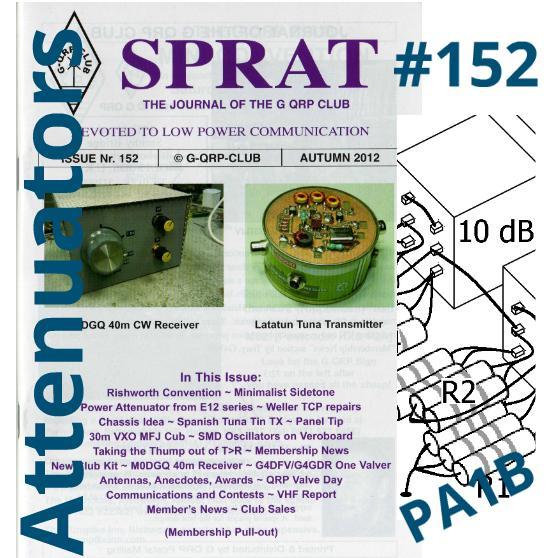
Sprat 152 features the article:
Power Attenuators with carbon resistors from the E12-series,
by Bert PA1B


I spent a lot of time and enjoyed making the drawing of the layout for this article in Sprat. 
But unfortunately the drawing of the layout published is Sprat 152, is  NOT correct. 

Please use this Corrected Layout to build your attenuators.

In the drawing of the layout the resistor R2 should be connected to R1 and R3. The resistor R5 should be conected to R4 and R6.
The arrows point to the right connections.


Markus DL6YYM found the info on the attenuators for 5 watts on the PA1B QRPp page and sent his questions by e-mail. In this e-mail exchange, I sent the schematic and the drawing of the layout of the 10 dB and 20 dB attenuators, that were published in Sprat 152. Markus discovered that the published layout is not correct, while he was building the attenuator. So here is the Corrected Layout. So I thank Markus, for his attentiveness. 

I already sent the corrected layout to George G3RJV and he replied, that the layout will be in the next issue.

Good luck in QRPp.


zondag 14 oktober 2012

10 dB Attenuators

I made a presentation on 10 dB Attenuators.

http://prezi.com/kfquunh0a93x/10-db-power-attenuators/

Please let me know, what do you think of it?

I use a free version of Prezi that I could use for a month. In this time I made this presentation. Now I can not longer change the presentation.

SPRAT 152 arrived

A few days ago Sprat arrived. I was eagerly awaiting the new Sprat. This new SPRAT 152 would contain an article, that I wrote about easy to build Power Attenuators with resistors from the E12-series.

I expected the SPRAT to arrive last week. But when it did not arrive in the following week, I was surprised. Then I went to the interesting Blog of Roger G3XBM, to see whether he already received his copy and writes about it. NO. Then I sent a mail to Roger. YES. Roger did receive Sprat, last week and wrote that he enjoyed the article. Tnx Roger.

I hope you all enjoy the article and have success and lots of FUN with you new build attenuators.
When the S-meter goes up, the power goes down. 

Not received SPRAT?
A quick search brought my to the GQRP club members new page with the following message at the bottom of the page:

Sprat 152 - 28/9/2012 - From G4WIF
The latest Issue 152 is now beginning to arrive but will probably not be complete worldwide until well into mid/late October. Please don't contact me if yours hasn't arrived until the end of the 3rd week of October. Please also don't assume that as your friend in the same town has their Sprat that yours must have got lost - as bulk mail can be unpredictable.

So I had to be pacient. hi

zaterdag 4 augustus 2012

Attenuators and tuning

50 Ohm attenuators
The attenuators shown on the PA1B Attenuator page are all very accurate 50 ohm attenuators. The accuracy is obtained by placing two, or more,  resistors in parallel, to form the required ohmic values very accurately, with resistors from the E12-series.
But the accuracy of the attenuators is also dependent on the termination of the attenuators. 
When the attenuator is terminated with 50 ohms, the attenuator will show also an input impedance of 50 ohms and most important, will give the right attenuation.

Setup
The attenuator will be placed behind the set. The SWR-meter is not shown in the drawing, but is placed between the attenuator and the tuner (transmatch). I work with this setup, as long as I work with the attenuators and by doing so, I made many fine QRPpp QSO's, using an inverted Vee as antenna.

The right setup.        Tune, as accurate as possible, for a SWR of 1:1,
Tuning
Tuning is done with the attenuator on bypass (0 dB). Tune carefully to get a SWR of exactly 1 : 1. When the SWR is 1:1, the input of the tuner will show an impedance of 50 ohms, so later with the attenuator switched on, the attenuator is terminated with 50 ohms and the attenuator will give the right attenuation. It's very important to tune for 1:1 as accurate as you can, to get a termination with 50 ohms for the attenuator.

SWR
I got an e-mail from a follow Blogger, Mike VE3WDM. He was using the autotuner of the Elecraft K3. The K3 is connected to  the SWR-meter, which is connected to the attenuator, which is connected to coax to the antenna. Mike wrote that he had a SWR of 1.6 : 1, with the attenuator on by-pass. Since the autotuner is in the set and the SWR-meter is behind the set, this means that the coax to Mike's attic antenna shows an impedance of 31.25 ohms or 80 ohms. (50/1.6 or 50x1.6)
The e-mail of Mike made me realize, it is not possible to use the autotuner in the set, together with the attenuators. The tuner has to be behind the attenuator. However, it is always possible to use another (homebrew) tuner behind the attenuators. Mike later said that he will place a tuner behind the attenuators and will turn off the tuner in the set . 

So place the tuner behind the attenuator and tune as accurate as you can to get a SWR of 1 : 1, to get the right attenuation. 

woensdag 1 augustus 2012

Accuracy of homebrew attenuators

To go below the lowest power of my FT-817, I use attenuators of 10 dB and 20 dB. The attenuators are built with resistors of 5%, but the accuracy is far better than 5%.

A few years ago the homebrew attenuators were measured, during a visit to Mischa PA1OKZ. The 10 dB attenuator turned out to be 9.95 dB. The 20 dB attenuators were 19.92 dB and 19.95 dB.
An excellent result for homebrew attenuators. So I have no doubt about the accuracy.
The accuarcy is much better than I expected.

Because I built the attenuators for a power of more than 1 watt, I had to use more than 6 resistors.
I calculated the values of the resistors with a pocket calculator and built the attenuators with resistors that were at hand, using the table from a informative article of Douwe PA0DKO.