Posts tonen met het label QRPp. Alle posts tonen

dinsdag 12 november 2024

ARI DX contest 2024

I participated in the ARI DX contest in May for just half an hour.
In this very short time I made 5 very nice QRPp CW QSO's.

The QSO's were all made with search and pounce.
In all QSO's I use the lowest possible power to answer a CQ.

When the signals are S9 I use 360 mW.
When the signal are very strong I use the PA1B 10 dB attenuator.
With a signal of S9+10dB I will reduce to 36 mW.
My antenna is an End fed sloping down to the east.

Prefx    Power        Miles     Miles per Watt   Cfmd  
HG6      36 mW      695      19300                       
IO5      360 mW     733      2037                          
IQ4      360 mW     580      1610                 eQSL  
IQ6      360 mW     699      1940                          
SM2     360 mW     1024    2845                 eQSL
        All QSO's on 14 MHz on an End fed               

Two QSO's in the contest are confirmed with an eQSL card. See below.

IQ4FA - 360 mW 580 miles - 1610 Miles per Watt

SM2M - 360 mW - 1024 miles - 2845 Miles per Watt

vrijdag 24 februari 2017

PACC 2017

In the PACC 2017 I made 51 QSO's. In most QSO's I used 800 mW by giving CQ or by using S&P.  The 20 m was good for most of the QSO's.
Friday before the PACC I made an End fed antenna with about 20 meters of wire. Just as my holiday antenna's the wire is feeded via a twin lead that acts as counter pose and impedance transformer. I applied linear loading to make the wire fit in my garden. This antenna is a great success.


Inside Europe I could make QSO's with QRPp running with just 800 mW. With 800 mW all QSO's over a distance of more than 800 miles (1280 km) are good for more than  1000 miles per watt. After the contest I counted 38 QSO's with more than 1000 miles per watt in my log.
The power of 800 mW was not enough in every QSO. I had to increase my power to 3.6 W, to work K6ND and P3YA and a few other stations.


The antenna is a great success.  I could run with QRPp with a power of 800 mW.


As a milliwatt enthusiast I often use the lowest possible power from QSO to QSO in other contests. Then I use Search and Pounce. (S&P) But when I give CQ, it is more difficult to copy the call than when I use Search and Pounce. Most of the time I must hear the call twice to copy the call. 
I enjoyed meeting operators that were patient. FB.

dinsdag 26 juli 2016

Stefano IZ1OQU makes SSB QSO's with 5 mW

Stefano IZ1OQU 5 mW SSB
with light weight VHFantenne
Hi Bert,
One year passed since our last email and now I write to tell you some recent news about my experiences with power attenuators in QRPp.
Last Sunday, during the Italian Apulia Contest VHF on 2 meters, I made 19 QSO's.
11 QSO's were completed with 5 mW, 4 with 50 mW and 4 with 500 mW. 
I never needed to repeat my callsign. No propagation, no e-sporadic: just directs. 
The best QSO was with a French station over 312 km, good for 62.400 kms per watt
My operating location was 500 m asl, with good opening to the sea and the French coast. I'm forgetting to say... That it was SSB!

The antenna is a personal design, low weight very easy to use on portable: two rectangles vertically linked to each other, with nice gain and good front/side. You can see it on my qrz.com. But I attach a photo for your comfort.

What an unbelievable experience! The first time with 5 mW drove me crazy. Surely VHF offers big chances to play with micro-powers, thank to big-gain antennas both on tx and rx sides, and global low power absorption. It is a test that I want to repeat as soon as possible, looking for DX.

Every time I think back to the day that I found your website: my life changed and my passion for QRPp now flies on golden wings. Thank you again, my friend.

Best regards
'73 de IZ1OQU Stefano

zondag 6 maart 2016

Confirmed DXCC countries with QRP

This table shows all the confirmed CW QSO's from September 2003 - August 2014, that I made under the call PA1B.

As a milliwatt enthusiast, I lower my power when the S-meter goes up. I often use the lowest possible power in each QSO. I use QRPp, when ever I can, but also use QRP when it is necessary to make the QSO. In most QSO's, I use S&P. This is search and pounce. I search on the band and answer a CQ of a loud station. I start with a low power and only increase my power when I am sure that my signal is not heard. I use attenuators to lower the power for QRPpp and QRPp. In every QSO that I make, I note my power in my log.

The table shows 12 power categories from 1 mW up to 5 Watts. But please notice that a QSO in the power category of 50 mW, can be made with a lower power than 50 mW. A power of 30 mW, 36 mW, 41 mW, 45 mW and 50 mW, are all  displayed in the power category of 50 mW.

Conformed DXCC-countries with QRP  -  PA1B

The total number 8 x 10 + 7 = 87 DXCC's.
I have made this table with great care. Please let my know, if something is not, what it should be.

zondag 21 februari 2016

QRPp QSO with the Booster

In the PACC I tested a new cylinder dipole - The Booster. I tested on 7 MHz and 14 MHz with 3 or 4 watts. I use my cylinder dipoles as indoor antennas. I placed the Booster in the dormer window.(dakkapel).

As a milliwatt enthusiast, I enjoyed to make 2 QSO's with QRPp, which is less than 1 W.
When the propagation peaked on Sunday morning, I heard PI4CC, with a very loud signal. S9++.  I reduced to 150 mW, before answering their CQ and made the QSO. In the next QSO with Erhard DL5JQ, I also used 150 mW. His signal was also very strong, S9++. In the next QSO I first tried 150 mW, but I needed the full power of 3 watts to be heard. hi.

Yesterday I answered the eQSL of this very special QSO, with Erhard DL5JQ. After answering the eQSL,  I have sent Erhard an email via eQSL to inform him of my power and my antenna.

Hallo Erhard,
Fabelhaft!! Dein Signal war sehr stark. S9++. Ich habe in unserem QSO, einer Leistung von 150 mW verwendet. QRPp. Ich bin ein begeisterter Milliwatter. Wenn die S-Meter nach oben geht, geht meine Leistung nach unten.

In diese PACC habe Ich einen Zylinder Dipol versucht. Meine Antenne ist eine zylindrische Dipol in der Dachgaube. Die Flügelspannweite beträgt 55 cm. Informationen über die Antenne:
http://pa1b-qrp.blogspot.nl/2016/02/the-booster.html
Aber schauen Sie sich auch, das Etikett Cylinder dipole an.

Dank für das nette QSO. Ich hoffe du nächstes Mal zu treffen, mit niedriger Leistung. hi.
Mit freundlichen Grüßen,
Bert PA1B

DL5JQ  - 40 meter  - 150 mW  -  Booster

OK dear Erhard, thanks for the nice QSO and eQSL.

vrijdag 3 oktober 2014

What is QRPpp

QRPpp is the (not official) term that I use for a power of less than 100 milliwatt.
Here is a nice diagram on QRPpp, QRPp and QRP.

How is it possible to use QRPpp?
Read the post QRPp How is it possible

zondag 22 juni 2014

Two eQSLs over more than 2000 Miles

RF9T  2080 miles and 800 mW gives 2600 MPW
In the batch of eQSL cards,
I received a card from from RF9T.

With a distance of more than 2000 Miles to UA9, its easy to make a more than 1000 Miles/Watt QSO, when I reduce the power below 1 Watt.


The eQSL card of RK9UE was received earlier and was made with even less power. hi


RK9UE  3126 miles and 360 mW gives 8684 MPW
1000 Miles per Watt is not as difficult as it seems.
When you hear a station over a distance of  500 miles (800 km), just reduce to 500 milliwatts.

woensdag 21 mei 2014

Notes from the SP DX contest

I never use a fixed power, but adjust my power from QSO to QSO.
Before I answer the CQ, I adjust my power to:  500 mW,  1 W, 2.5 watts or 5 watts.
If the signal is very strong, I use the S-meter to determine the power that I wil use.
For example: a signal of:  S+ + 10 dB, I can answer with 50 mW,
To make such a low power I use an attenuator of 10 dB.

To enter the call or write down  the call and to set the power at the same time, is impossible,
So I am always too late for the first opportunity to answer.
And sometimes, I even switch to the wrong setting, which can be to low or to high. hi

Using the lowest possible power is great fun, but can also be a nerve wracking enterprise.

Interesting Experiences      Wow's and Woo's from my handwritten notes, made during the SP DX 2014
* In the QSO with SP8HW I realized that listening is very important.
    When I started to answer a CQ, I heard an other station answering, in the background.
    When he stopped, I gave my call twice, in the clear and made the QSO with 500 mW.
* I worked 3Z50AYP in a hurry. I was so excited, that I used 500 mW instead of a lower power.
    After the QSO it was quiet on the frequency. But a dupe will be impossible. ;-(
* SP6EIY can not hear me with 500 mW and 1 W. Maybe later.
* I seized the opportunity to switch back to 500 mW, while waiting  for a very loud station.
    It's important to immediately adjust to 500 mW, after a QSO with 1 W or 5 W.
* I had to push to make a QSO with SP2GJV with just 50 mW, which is quite remarkable.
    There was a lot of QRM in the background.
* Station after station, visited SP3FYX.
    I had to have a lot of patience, not to increase the power to 5 watts.
    And finaly, to use just 500 mW.
* I love chirpping stations. I work SP7.... with 5W.
* Worked SP9YFF with 500 mW, before I got the call complete.
    I realized that . . . FF was a new one.
* After the QSO with SN8N, I realize that I should have used 50 mW instead of 500 mW.
    The signal was earsplitting loud. S++
* One station after the other goes in to the log. It 's a mix of 500 mW and 5 W.
* It's very busy. I have to look for stations that are calling CQ with no takers.
* SP6ZDA At the last moment, I decide to switch in the 10 dB attenuator.
    Resulting in a QSO in the clear, with just 50 mW.
* Now I recognize new stations by the last letters of the call.
* 3Z8Z fades. I need 5 W.
* The numbers of my computer program and the Morse Machine differ.
    I correct the Morse Machine.
* SP9MZS Earsplitting signal. But the setting is wrong, so 500 mW instead of 50 mW.
    Next time better.

    I could make all these fine QSO's, thanks to all the fine operators in the from Poland.

maandag 5 mei 2014

SP DX contest

Poland - Voivodeships
My objectives
As a milliwatt enthusiast I tried:
* to make as many QSO's with the
   lowest possible power
* to make as many 1000 Miles per Watt QSO's as
   possible
* to work as many different prefixes as possible for the
   BQC- Marathon.

1000 MPW
The distance to many of Voivodeships is more than
500 miles  from my QTH in JO22na.
Only the distance to the Voivodeships Z, B, D and
a part of W, is less than 500 miles.
With a power of 500 mW, and a distance of more than 500 miles,
these QSO's will be, more than 1000 Miles per Watt QSO's.

Crippled antenna
This year I did not expect much of my Inverted Vee.
Last year the top broke and I fixed the antenna temporarily.
The top is now just 2 meters above the roof.
And recently I found out, that the 300 ohm ribbon is damaged, so only one wire is still connected
But the antenna worked better than I expected.
Click here to read about the state of the antenna.

1000 Miles per Watt
The number in red, show the QSO's with more than 1000 Miles per Watt.


zondag 11 augustus 2013

CQ WW WPX CW 2013

In every contest it is possible to make QSO's with very low power.
The stronger the signal, the less power is needed, to answer a CQ.
I had very much fun with low power.
Many of the QSO's are good for more than 1000 Miles per Watt.


dinsdag 12 februari 2013

QRPp in the ARRL int DX contest

In my first ARRL international DX contest, I used 5 watts. My exchange 599 005 gave no problem for the receiving station.  In CW of course given as:  5NN TT5.
It was obvious, that I was using QRP.

I very much like the ARRL international DX contest. In this contest, the DX stations, like myself, will give their power in the exchange. So the receiving station knows immediately, that I am working with QRP.


 When the S-meter goes up my power goes down. 


In most contest QSO's, I often use the Lowest Possible Power, in each QSO, using S&P.
When I hear a station calling CQ, I look on the S-meter to determine the power with which I will answer.

In later years, I reduced to 500 mW, when the propagation was very good. The use of 500 mW in a contest QSO is no problem, because most of the time, the response will be immediate and correct.

pwr? . . .100? . . . 1kW?  .  .  .  .  .  .  . 1W FB


The lowest value for the power in the Cabrillo file is 001.
Over the years, I found out, that when I was using 1 W, it was best. to use the exchange 599 001.

How to indicate, that I am using only 500 mW? Well, that's simple. The DX station give their estimated power. So for a power of less than 1 W, I also give the exchange : 599 001.

But don't think that all problems are gone with 599 001. Some stations keep asking pwr?, because they think that 001 is a number or they respond with 100? or even 1kW?.
In that case I will respond with:   599 1W 1W 

* I met operators, that fall out of their chair, when they realized, that my exchange 599 001 indicated, that I was using only 1 watt.
Two seconds of silence and an additional "1W FB", from a station that is transmitting not a letter to many, I consider a huge compliment. hi

Please notice that when you use low power, that any QSO between Canada or the USA with Europe with 3 Watts or less, is good for 1000 Miles per Watt.

Power of the FT-817 at PA1B's, after serious mis-match.

zaterdag 12 januari 2013

Award for the IARU HF 2011

I enjoyed participating in the IARU HF World Championship 2011.
After I came home from my holiday, I discovered that I had not sent in the Log. At first I was disappointed, but then I realized that the activity that the contest offers, provides the opportunity to make interesting QSO's.  I had great fun with QRP and QRPp in 125 QSO's, of which many are 1000 Miles per Watts QSO's. Despite the deadline I sent in.

At the time I sent in the Log, I wondered whether my log would be marked as check log or would be ignored.
The contest robot immediately replied with a e-mail, in which he stated that the Log was received ***AFTER DEADLINE***. And in the same mail the robot kindly thanked my for participating and for submitting the log. hi.


Click on the
label: IARU HF
at the right to see the
related Blog entries.


A while back, to my surprise, I received a beautiful
Award for the IARU HF World Championship 2011.
Country winner:  First place - Single operator - CW only - QRP
It's great fun to participate with QRP and QRPp, but it's even more fun to receive an Award.
I very much like this gesture of great sportmanship.
So my thank goes to the Contest Commity of the IARU HF World Championship. (VE6SH and his team)


zondag 14 oktober 2012

SPRAT 152 arrived

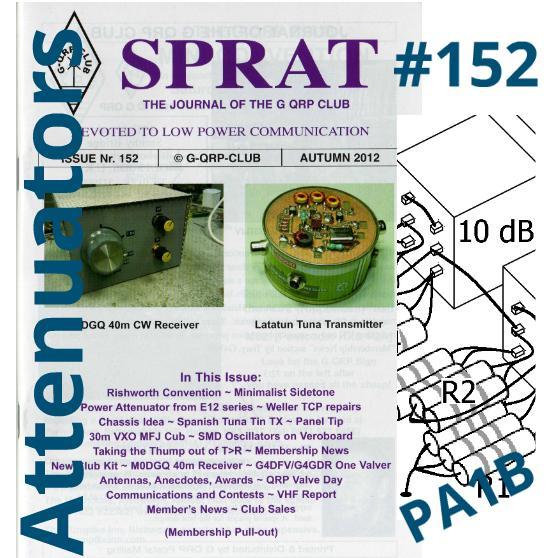
A few days ago Sprat arrived. I was eagerly awaiting the new Sprat. This new SPRAT 152 would contain an article, that I wrote about easy to build Power Attenuators with resistors from the E12-series.

I expected the SPRAT to arrive last week. But when it did not arrive in the following week, I was surprised. Then I went to the interesting Blog of Roger G3XBM, to see whether he already received his copy and writes about it. NO. Then I sent a mail to Roger. YES. Roger did receive Sprat, last week and wrote that he enjoyed the article. Tnx Roger.

I hope you all enjoy the article and have success and lots of FUN with you new build attenuators.
When the S-meter goes up, the power goes down. 

Not received SPRAT?
A quick search brought my to the GQRP club members new page with the following message at the bottom of the page:

Sprat 152 - 28/9/2012 - From G4WIF
The latest Issue 152 is now beginning to arrive but will probably not be complete worldwide until well into mid/late October. Please don't contact me if yours hasn't arrived until the end of the 3rd week of October. Please also don't assume that as your friend in the same town has their Sprat that yours must have got lost - as bulk mail can be unpredictable.

So I had to be pacient. hi

zondag 4 maart 2012

UBA DX CW Contest (2)

In most contests, I use the lowest possible power in each QSO.
Also in this contest I started with search and pounce with low power.
But because a station from the Netherlands is a wanted station in this contest, I also tried to called CQ myself, using 2.7 W.
Very occasionally I was heard by more than one station, who would than call at the same time. But on other moments my QSO-rate dropped, when I called CQ. So then I would go back to S&P after a few QSO's.

QSO-rate
I calculated that I made one QSO in two or three minutes, while searching on the band, answering stations that are calling CQ.
When not too many other stations are also answering, I don't have to wait long to make a low power QSO.
I tent to answer, with more power than needed, when I have to wait for a longer time.

The bands
14 and 21 MHz were good. On 14 MHz the lowest power was used.
On 14 MHz 80% of the QSO's were made with QRPp and on 21 MHz only 50%.


When the S-meter goes up, the power goes down.

zondag 19 februari 2012

QRPp How is it possible

When I started as a HAM, 20 years ago, I used my homebrew transceiver HM7, from Solid State Design, page 214...218, with an Inverted Vee, to work many different DXCC countries in Europe in CW. Because my power was only 500 mW, I had to look for stations, that I received with 599 or more, so the other station could hear my QRPp signal of 500 mW.
During daylight hours my RST would be 559, or even lower.
Please notice that a power of 500 mW is only four S-points weaker than 100 Watts.
See the PA1B QRPp page.

D and E layer
The radio wave is not attenuated when it is reflected by the E-layer. (Total reflection) But during daytime the signal is attenuated by the D-layer, when it passes through the D-layer.
During daylight hours, the signals are attenuated by the D-layer, which is absorbing

I discovered, that when darkness fell, the signals from the south of Europe would be very loud. So this made it easy, to make QSO's over a distance of 1000 km or more. When the D-layer disappears during the night, the signal can reach the the E-layer without attenuation in the D-layer.

The E-layer reflects the signal without attenuation

When the D-layer disappears, there is no attenuation in the radio path. The signal is reflected by the E-layer without attenuation. The attenuation of this sky wave is (only) 6 dB for a doubling of the distance. So the signal will be very strong.
At first, I did not realize, that my own QRPp signal, could also be an earsplitting 599, until I got genuine report from Italy, that my signal was S9, while using just 500 mW.

How low can you go
I was wondering, what the lowest possible power would be, if I would reduce my power in that situation with this excellent propagation.


If I reduced my power, so my RST would be 559, the difference is 4 S-point. This is a reduction in power of 4 x 6 dB = 24 dB which is 4 x 4 x 4 x 4 = 256.
So I could reduce the the power from 500 mW to about 2 milliwatts.

I was surprised by the low value, that I calculated, but this value is very realistic.
From 2001 on, I made many CW contest QSO's over more than 1000 Miles with 2.5 mW and 5 mW,
using PA1B homebrew attenuators.

I discovered that the frequency must be absolutely clear, when you use very low power.

vrijdag 17 februari 2012

Power in Cabrillo file in the ARRL int DX contest

I very much like the ARRL international DX contest. In this contest, the DX stations like myself, will give their power in the exchange. This is great for a QRP station, because my power is directly visible to the other station.

QRP
In my first ARRL international DX contest, I used 5 watts. My exchange 599 005 gave no problem for the receiving station. It was obvious, that I was using QRP.

As a milliwatt and low power enthusiast, I often use the Lowest Possible Power, in each QSO. When I hear a station calling CQ, I look on the S-meter to determine the power with which I will answer.
The higher the S-meter reading, the lower my power can be.
When using the lowest possible power, I do not call CQ myself.

In later years, I reduced to 500 mW. The use of 500 mW in a QSO was no problem, because I will often get an immediately correct response, but the problem was my exchange. How to indicated, that I was using only 500 mW.

599 001
Over the years, I found out, that when I was using 500 mW, I best could use the exchange 599 001. The value 001 is the lowest value, that can used in a Cabrillo Log.

Pwr?
But don't think that all problems are gone with 599 001. Some stations keep asking pwr?, because they think thay 001 is a number or they respond with 100? or even 1kW?. In that case I will respond with "599 1W 1W".

* I met operators, that fall out of their chair, when they realized, that my exchange 599 001 indicated, that I was using only 1 watt.
One second of silence and an additional "1W FB", from a station that is transmitting not a letter to many, I consider as a huge compliment. hi

* Please notice that when you use low power, that any QSO between Canada or the USA with Europe with 3 Watts or less, is good for 1000 Miles per Watt.

maandag 26 december 2011

ARRL 10 meter contest 2011

During the ARRL 10 meter contest the propagation and the activity was very good. This combination yielded in 72 QSO's. Most QSO's were made with the Lowest Possible Power. Because of family obligations, I only participated for for about 3 1/2 hours each day. Before 1200 utc, I could work only stations from the east and after 1200 utc from the west. All QSO's were made with a power of 2.7 W to 36 mW. Many of the QSO's with low power are good for more than 1000 Miles per Watt.

I was very pleased to meet Steve NY3A over 3800 miles from PA. His signal was strong. I answered his CQ with just 80 mW. I was surprised that he could hear me, but no doubt, because the response was immediately correct. WOW.
But also QSO's with 2.7 Watts can be remarkable. I was thrilled by the Excellent Ears of KI1G, UA9FGJ and EA8OM. I answered their weak signal and they came back immediately with a correct response. WOW again.
In my log, I use EE to designate a station with Excellent Ears and IC in case of an unexpected Immediately Correct response.


The most difficult part of using the lowest possible power, is to choose the power. If I choose a power that is too low, I loose much time. When a station is time and again calling CQ, that is no problem. Then I use low power and increase the power every time I notice, that my signal is not heard.


By using low power, 53 of the 72 QSO's (74%) are made with more than
1000 Miles per Watt. All QSO's with 1.8 W or less are 1000 MPW QSO's.
And also all 23 QSO's with 2.7 W to the USA.

woensdag 22 juni 2011

More than 1000 MPW eQSL's from the CQ MM DX contest.

Using the lowest possible power in a contest QSO is not so difficult as it seems. In the CQ MM DX contest I was suprised by the excellent propagation, which made it possible to work with stations in South America and North America with just 1 W or 2.5 W.

2 Way QRP QSO with Brasil


After 8 QSO's with 1 W and 2.5 W, I heard PY2WC calling CQ, so I tried 2.5 W.
I fell off my chair when Waldir answered: SAQ, which means that he was using QRP and this was a 2 way QRP QSO. It was only after a few QSO's, also with 2.5 W, I realised that I could have made the QSO with a lower power.
More than an hour later I heard Waldir again and made a second QSO, but now with 1 W (980 mW). Thank you Waldir for a new DXCC in QRPp, thus less than 1000 mW.

Tip: Just make a second contest QSO, with a lower power if you can.
My most memorable very low power QSO with 0.85 mW with RT6A is a Dupe. hi

Confirmed "More than 1000 MPW" QSO's


This list shows only the 1000 MPW QSO that are confirmed via eQSL.
I actually made many more 1000 MPW QSO's in the CQ MM DX.

After I receive an eQSL, I determine the distance using the QTH Locator and the Miles per Watt.
I place the 1000 MPW info in the comment field of the return eQSL.
E.g. 2.5 W and 6062 miles to GG66un gives 2425 miles/watt - 73, Bert

Power Overview


Most QSO's were made on 21 MHz.
Although I made many DX QSO's 34% of the QSO's were made with QRPp.
And 70% with more than 1000 MPW.

The Soapbox:

In total I made 56 QSO's in the CQ MM DX contest. I worked SA, NA EU and SA. I had great fun.
My RIG is a FT-817 and the antenne is an Inverted Vee.
I always use QRP, but never a fixed power of 5 watts.


Thanks to all the excellent operators that made this contest QSO's possible.