Posts tonen met het label DL6YYM. Alle posts tonen

zaterdag 30 november 2019

Mark DL6YYM uses WSPR with 1 miiliwatt

I received a very interesting email from Mark DL6YYM about his WSPR adventures first with 20 milliwat and later with 1 milliwatt. Mark makes 1 milliwatt by using an attenuator of 13 dB behind the beacon of 20 milliwatt. Thank you for the very nice info, dear Mark.

-   -   -   -   -   -   -   -   -   -   -   -   -   -   -   -   -   -   -   -   -   -   -   -   -   -   -   -   -   -   -

Hi Dear Bert,

From time to time I visit your nice blog. Some weeks ago I read from QRPPP WSPR on your site. 

In the next step I found a very nice project from Alexander RA9YER 

http://ra9yer.blogspot.com/2016/05/arduino-si5351-beacon.html

It's based on ARDUINO and SI5351 

From the SI5351 come about 14-15 dBm output 8 Khz - 160 MHz.
I set the frequency in the script. The complete investment is about 25,00 €.

To the left - Powermeter and Attenuator In front - SI5351 and Arduino - DL6YYM 

Last week I make the first tests on different bands.
Yesterday afternoon I put my attenuator 10 + 3 dB (your idea 8-)) between the SI5351 and my antenne.
My output in the shack ==> 30m Aircell 7 ==> R8 vertical.

In the table below is the result on 40m :-D

DL6YYM with WSPR with 1 milliwatt on 7 MHz
It's a nice fun but CW is better ;-)
But I hope I can make a stand alone TX in the next time.
best wishes es

vy 72 & 73 de Mark DL6YYM nr Leipzig DLFF-050

More info on the DL6YYM Website.

DL-QRP-AG Nr.: 3336 // RU-QRP-Club Nr.: 331 // RTC Nr.: 406 // AGCW-DL Nr.:  3851

amateur radio parts www.bamatech.net

Powermeter and attenuator (set to 13 dB - DL6YYM 


woensdag 16 december 2015

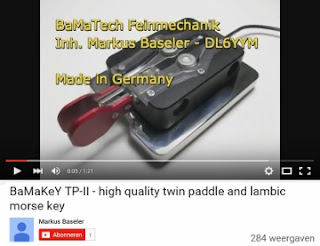
BaMaKeY TP-II - high quality twin paddle and lambic morse key

Markus DL6YYM emailed my, to show his high quality twin paddle key that he produces in his small company. The video gives a good impression of the design and operation of the key.

 Video

The video of the key with all the interesting details, can be found on Youtube;
https://youtu.be/neVx2siF6kM

The technical details and price can be found in this pdf document:
http://www.bamatech.de/dl6yym/BaMaKeY%20TP-II%2006-2015_a.pdf


Designed and built by Markus DL6YYM

Excellent for portable operation
In the shack on the magnetic base

Technical details
Hard anodized aluminum housing,
All brass parts chrome plated,
High precision ball bearings,
Sensitive adjustment of stroke and preload,
Preload adjustable with magnets,
Silvered and golden contacts,
Connecting cable with 3,5mm plug
Weight: 200g / 7,05 oz  -  Dimensions: 0,87x1,97x2,76 (4,33)''

Optional available is a brass chrome plated magnetic base brass chrome plated.
With this magnetic base the portable paddle key can be used as your station paddle key.
Strong magnets hold the travel paddle connected to the base.
Weight: 400g / 14,1 oz  -  Dimensions: 0,31x2,76x3,54''

WOW, Markus. I am impressed. It's a beautiful design.

zondag 18 november 2012

Power Attenuator by Mark DL6YYM

Mark DL6YYM designed a power attenuator for 5 watt, using resistors of 1/2 watt. The attenuation of the attenuators, from the left to the right, is 20 dB, 10 dB, 3 dB and 3 dB. Seen from the front. This enables Mark to lower the power from 0 dB to 36 dB, in steps of 3 dB or 4 dB.

Click to enlarge


Mark built a beautiful enclosure for the attenuators.


This picture shows the interior. Seen from the back, you can see the 20 dB section on the right, behind the coax. This section has the larger number of resistors. The 10 dB is visible to the left of the 20 dB section.
At the left you can see the two 3 dB sections, each built with a total of 7 resistors.
Click to enlarge, to see all the details.


Mark used the PA1B Power Attenuator Calculator, to design the attenuators.
You can find the Calculator on the PA1B QRPp page,  This Calculator in Excel enables you to design an attenuator for any power, using common resistors from the E12-series. E.g. 1/2 watt. Mark used Open Office. Please note, that in Excel or Open Office you must use the decimal COMMA or POINT according to your national language. These attenautors are what I had in mind, when I developed the Power Attenuator Calculator. hi


The shack of DL6YYM.

I thank Mark for sending the pictures and for the great feedback on the attenuators.