Posts tonen met het label WSPR. Alle posts tonen

zaterdag 30 november 2019

Mark DL6YYM uses WSPR with 1 miiliwatt

I received a very interesting email from Mark DL6YYM about his WSPR adventures first with 20 milliwat and later with 1 milliwatt. Mark makes 1 milliwatt by using an attenuator of 13 dB behind the beacon of 20 milliwatt. Thank you for the very nice info, dear Mark.

-   -   -   -   -   -   -   -   -   -   -   -   -   -   -   -   -   -   -   -   -   -   -   -   -   -   -   -   -   -   -

Hi Dear Bert,

From time to time I visit your nice blog. Some weeks ago I read from QRPPP WSPR on your site. 

In the next step I found a very nice project from Alexander RA9YER 

http://ra9yer.blogspot.com/2016/05/arduino-si5351-beacon.html

It's based on ARDUINO and SI5351 

From the SI5351 come about 14-15 dBm output 8 Khz - 160 MHz.
I set the frequency in the script. The complete investment is about 25,00 €.

To the left - Powermeter and Attenuator In front - SI5351 and Arduino - DL6YYM 

Last week I make the first tests on different bands.
Yesterday afternoon I put my attenuator 10 + 3 dB (your idea 8-)) between the SI5351 and my antenne.
My output in the shack ==> 30m Aircell 7 ==> R8 vertical.

In the table below is the result on 40m :-D

DL6YYM with WSPR with 1 milliwatt on 7 MHz
It's a nice fun but CW is better ;-)
But I hope I can make a stand alone TX in the next time.
best wishes es

vy 72 & 73 de Mark DL6YYM nr Leipzig DLFF-050

More info on the DL6YYM Website.

DL-QRP-AG Nr.: 3336 // RU-QRP-Club Nr.: 331 // RTC Nr.: 406 // AGCW-DL Nr.:  3851

amateur radio parts www.bamatech.net

Powermeter and attenuator (set to 13 dB - DL6YYM 


zaterdag 20 april 2019

KX4AZ WSPR with 10 milliwatt

Last week I received a very nice e-mail from Bruce KX4AZ. He searched the net with "WSPR 10 milliwatt" and found the page on "WSPR with 10 milliwatt" on my PA1B website. hi.

Bruce KX4AZ is a operator that makes very interesting WSPR spots with just 10 milliwatt.

Believe it or not. A WSPR station with 10 mW will be spotted, but ONLY when the propagation is very good. Please study the diagrams below, to convince your self.

Lowest Possible Power diagram
To show the propagation, I developed the Lowest Possible Power diagram. You can immediately see how good or how lousy the propagation is, for each individual spot.
The better the propagation, the lower the Lowest Possible Power.

2019-04-19 I visited the WSPR old database and collected some interesting spots.

Time slot 1 
In the time slot of  17:46 UTC ND7M spotted 7 stations.
4 stations with 5 W, 1 station with 1 W, W6CLB with 100 mW and Bruce KX4AZ with 10 mW.
Luckily for Bruce, the propagation from the stations with 5 W and 1 W, to ND7M was not that good, so Bruce's signal was not over shouted by the 1 W and 5 W signals. Something that can easily happen, even with a power of 100 mW.
In the first diagram Bruce was spotted by ND7M with a SNR of -29 dB. It's the spot in yellow, on the line of -29 dB and the line of 10 mW. So in this time slot Bruce needed the full 10 mW. Hi.
In this time slot the best propagation is shown by the spot of W6CLB with 100 mW and a SNR of  -15 dB. This spot has a Lowest Possible Power of 5 mW. Thus about 3 dB better than the spot of Bruce.
KX4AZ with 10 milliwatt spotted by ND7M over 3100 km
Time slot 2
The second diagram shows the next spot of KX4AZ by ND7M
In this time slot the signals of W6CLB with 100 mW has a SNR of -12 dB.
The signal of KX4AZ has a SNR of -22 dB. please notice that both spots, show the same propagation, which is very good. The Lowest Possible Power of both stations is 2 mW. The signal of Bruce is even about 7 dB stronger, than in the first time slot.

KX4AZ with 10 milliwatt spotted by ND7M over 3100 km


zaterdag 9 februari 2019

Very Good Propagation with WSPR

With this table you can immediately judge the propagation from your WSPR spots.
For example, when your 1 Watt WSPR signal is spotted with a SNR of  -9 dB,
or higher, the propagation is very good.
If you notice that the propagation is very good, consider to reduce your power.

Judge the Propagation with your WSPR signal
A WSPR beacon with a power of 10 milliwatt, will ONLY be spotted, when the propagation is very good. WSPR with 10 milliwatt can be compared with a CW beacon with a power of  200 milliwatt.

donderdag 8 mei 2014

G4ILO Whispering with 20 mW and 1 mW

This is an other analysis of the data collected from the
WSPR database for spots of Julian G4ILO.
Julian transmitted with a power of 1 mW and 20 mW.

The table shows, that the spots that were made with 1 mW, 
were about 10 dB weaker than the spots made with 20 mW

The table shows a selection stations that received spots made with both 20 mW and 1 mW
To compare spots over different distances, I use the 
Calculated electrical field strength, E, in microVolt per meter.
For details see the WSPR Propagation Analysis page of this Blog.

The lower the electrical field strength the better the propagation.

A power ratio of 10 means 10 dB
Please notice the the value for E is given in Volt/m, so a Voltage ratio of 10 means 20 dB
Which is indicated at the top of the table.
A Voltage ratio of 10 is a ratio of 100 in power.

The table shows stations that received the signals, that were transmitted with 1 mW and 20 mW.
Notice the difference in field strength in spots made with 1 mW or 20 mW.
The difference in field strength between the spots of 1 mW and 20 mW is about two steps in this table.
This is about 10 dB.
This is no surprise because, the difference in power between 1 mW and 20 mW 
is  10 log (20 / 1) = 13 dB.

The differences in propagation are huge
The field strength of the spots made with 20 mW, received by ON7KO over 600 km, 
show a value of 0,3 microV/m to 0,03 microVolt/m. 
The ratio in voltage is 10 and the ratio in power is 100, which is 20 dB. Wow


vrijdag 11 april 2014

"WSPR Propagation Analysis" for WSPR spots of G3XBM on 10 m

Roger, G3XBM wrote:
Nothing at all was seen until mid-afternoon and then the band just opened wide!  
K9AN (6505km) last spotted my 2W signal at 2308z, which is after midnight local time and HOURS after the band has normally died out. It had been dark for hours. One wonders if this was F2 or even multi-hop Es? I wonder what was happening on 6m transatlantic?  I must check.
(Spots made on 2014-04-08) Click to visit the article.

I was interested, so I made an WSPR Propagation Analysis of the spots on that day and the days before. The second table shows the last spot at 23:08 UTC, but also reveals the rapid change in propagation around 22:20 UTC.

How to read the table 
In the analysis above, I show the "Calculated Lowest possible Power" in milliwatt and the hours of the day in UTC. The lower the "Calculated Lowest Possible Power", the better the propagation.
To compare the propagation over several days, 
I included 2014-03-28 till 2014-04-08.


Roger is refering to WSPR spots made on 2014-04-08.
At the bottom of the table above.
From 10 UTC to 22 UTC the propagation gets better.
The best propagation occurred in the spot with the red star made on 22:20 UTC.


Even more spectacular
The best propagation on 2014-03-28, at the top of the table, occurred between 13:00 and 15:59 UTC in the aftenoon.
But even more spectacular is the change in propagation in the 3 spots * that were made between 22:00 and 22:22 UTC, that show a very rapid chang in propagation. (See the red arrows)

Thanks to Roger for the interesting experiments with WSPR.

maandag 27 januari 2014

Analysis of G3XBM's 40m WSPR spots with 5 mW

G3XBM left WSPR running with 5 mW on 40m for 24 hours.
Roger concluded that his signal was in the noise most  of the time.
He also concluded that he would need 2 W.
http://g3xbm-qrp.blogspot.nl/2014/01/40m-5mw-summary.html
The analysis below shows that the conditions changed dramaticly after the 7 spots with 5 mW.

The header of the table shows the Calculated  Lowest Possible Power in mW (Click for info), 
which is calculated from the used power (Pwr Sent  in mW) and the SNR.

The better the propagation, higher the SNR and
the lower the Calculated Lowest Possible Power will be.

The analysis
9 UTC gives the spots that were made in the hour from 9:00 till 9:59 utc.
This first line shows, that the power that was needed for the spots was 1 W down to 2 mW
In this hour, half of the spots that were made with 2 W could be made with 100 mW.
The white circles indicate the power with which half of the spots could be made.
The lower the power needed, the better the propagation.


From 9 utc till 14 utc on the 18th there are 11 spots with a calculated lowest possible power of 5 mW or less. So it was possible to make spots with 5 mW.

WSPR with 5 mW
From 14 utc Roger reduces further to 5 mW and over 24 hours only 7 spots were made, shown in the yellow coloured part of the table. In the red part of the table there are no spots since the power that was used is 5 mW. In the red part I show the receiving stations and their SNR.

Back to 2 W
You would expect more spots, since the 24 hours before showed many more spots that could have been made with 5 mW. But the conditions changed dramaticly.
The last part of the table shows spots that were made with 2 W.
At 20 utc on the 20th at least 500 mW is needed.
And at 5 utc and 7 utc spots could have been made made 5mW


zondag 12 januari 2014

WSPR Propagation Analysis

Changes in propagation give huge changes in signal strength. 
WSPR has a SNR that can act as an S-meter. 
But if you want to compare WSPR spots, you also have to take 
into account the output power of the transmitter. 

WSPR Propagation Analysis
I use the calculated lowest possible power
in milliwatt of each WSPR spot, when
  • the spots are all made over the same distance
  • the spots are made with different power.

The lower the calculated lowest possible power
the better the propagation.

Solid copy
The SNR of a WSPR signal can be as low as -33 dB.
But a WSPR signal that is received with a SNR of -29 dB will be a solid copy.

Calculated Lowest Possible Power
A signal with an SNR of -19 dB is 10 dB stronger,  can be reduced with 10 dB
(1/10th of the power) and still be solid copy, but then also with a SNR of -29 dB.


The better the propagation, the stronger the signal and the higher the SNR will be.
The more the power can be reduced and the lower the Lowest Possible Power will be.

But the frequency must be clear, to actually receive a signal with the Lowest Possible Power.

donderdag 9 januari 2014

G4ILO Whispering with 20mW

Yesterday Julian G4ILO wrote on his interesting Blog about his advantures with WSPR with low power:

Many people who operate the weak signal mode WSPR use too much power. 
If you don't use very low power (QRPp) you'll never find out what this mode is capable of. 
So to remind myself I thought I'd do some whispering on 10m using 20mW of power. 
It's easy to use low power with the Elecraft K3 as the power level is adjustable in 0.01 watt increments. 

The power of 20 mW that julian used to WSPR can be compared with 400 mW in CW. (13 dB --> 20x)

Today I visited the WSPR database to make the following analysis.
In each spot I calculated the lowest power what could be used, to be received with a SNR of -29 dB.
The stronger the signal, the lower the lowest possible power.
The stations that received the strongest signals are ON7KO (600 km), LA9JO 1900 km) and ND6M (6600 km)


zaterdag 16 maart 2013

WSPR with 1 milliwatt

WSPR Database                                                         Click: http://wsprnet.org/olddb 

Go to the WSPR Database to see what is possible with very low power with WSPR.
First choose the band of interest.
Then select sort by: Power
Reverse the order to find the low power spots.
You can see more than 50 spots. Maximum number of spots is 20000. hi.
The lowest power value that can be uploaded to the Weak Signal Propagation Reporter Network
is 1 milliwatt, which is 0 dBm.
Please ignore all the spots with less than 1 mW.

Results with 1 milliwatt
The table below shows spots for 1 mW. (+0 dBm)  The short table below shows spots that were made with  the 1 milliwatt. The signals have traveled a considerable distance.
In this table all the received signals are "solid copy", since all the signals are received with a SNR of -29 dB or more. The higher the SNR, the stronger the signal.
In one of the spots Joe, K1JT is  received with a SNR of +11 dB. (Horizontal arrow)
This is 40 dB above the threshold for solid copy in WSPR of -29 dB. The signal could still be received if Joe had used a 40 dB lower power. Thus with 0.1 microWatt. hi
For more info on this calculation, please click on: Calculated lowest possible power in a WSPR spot.


WSPR with 1 milliwatt can be compared with CW with 12 to 30 milliwatt 
or SSB with 100 to 400 milliwatt.

zondag 3 maart 2013

SSB vs WSPR

Bas PE4BAS asked me about the difference in power of WSPR compared to SSB.  
In various publications, the difference between SSB and CW, is given as 13 dB.
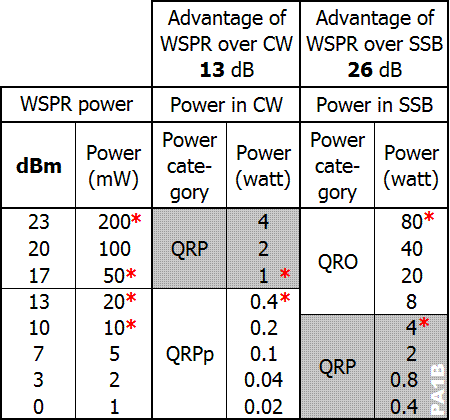
The difference in power between CW and WSPR is 13 dB(Click) 
Or somewhere between 15 dB and 11 dB.
So when I take a figure of 13 dB for both values above, I estimate that the
difference between SSB and WSPR is 13 + 13 = 26 dB or 20 x 20 = 400 in power.
So 400 W in SSB can be compared with 1 W in WSPR.

WSPR - CW - SSB
For an advantage of 26 dB, the power in WSPR can be  1/400th of the power in SSB or 1/20th of the power in CW. This means that the power in WSPR, must be much lower, than the power used in SSB.

My choice for a value of 26 dB is just a guideline to choose your power in WSPR.
If you use a speech processor, you can use a lower value than 26 dB. E.g. 22 dB.
So you can use WSPR for a propagation analysis, to see what is possible with your SSB station.

How to use WSPR to see what's possible with SSB
A power of 80 Watts in SSB or 4 W in CW, can be compared with a power of  200 mW in WSPR.
If you want to know where your SSB QRP signal of 4 Watts will be received, you should use a power of 10 mW in WSPR.


As a CW enthusiast you can use WSPR spots made with 20 mW or 50 mW to analyse with WSPR where your CW signal of 400 mW to 1 Watt can be heard. 

Please notice that 5 Watts in WSPR can be compared with about 2 kW in SSB. hi

zondag 3 februari 2013

Power with WSPR


WSPR vs CW 13 dB
How much power should be used with WSPR?
WSPR is a beacon system. The WSPR data can be used to probe radio frequency propagation conditions.  
WSPR uses a low transmission speed.
The lower the transmission speed, the lower the power, that is needed. 

As you will see:  Please WSPR  with QRP.

Roger G3XBM asked Joe Tailor K1JT about the difference between "CW by ear" and WSPR.
Roger placed Joe's response in an entry
on his Blog:
WSPR versus CW - what's the improvement
Click to go to the article.
In a description on the WSJT web site, Joe gives a comparison between WSPR and CW by ear
For "CW by ear" Joe gives a SNR of -18 dB for a very skilled human CW opererator.
Joe gives a value of -29 dB for the SNR for a WSPR signal.
So the difference is 11 dB, but Joe estimates that for most operators, the SNR has to be even 15 dB


I estimate that the difference between WSPR and "CW by ear"  is about 13 dB for contest CW operators and 15 dB for most operators.

For an advantage of 13 dB, a power of 5 Watts in WSPR, can be compared with 100 W in CW.
So the power in WSPR can be 1/20th of the power in CW.
The value of 13 dB is guideline to estimate the power that you should use in WSPR to approach the situation that you use with CW. 

For an advantage of 15 dB a power of 5 Watts in WSPR, can be compared with 150 W in CW.
So the power in WSPR can be 1/30th of the power in CW.


Calculating with power, 15 dB corresponds to a factor 30,
13 dB is 20x, and 11 dB is 12.5x
Calculating with voltage, 15 dB corresponds to a factor 5.5,
13 dB is 4.5x and 11 dB is only 3.3x


I made a table below to compare WSPR with "CW by ear".
The table shows the values for 15 dB, 13 dB and 11 dB. So you can choose the value yourself.
Please note that a difference of 2 dB or 4 dB is very small compared to the large daily fluctuations (in dB) caused by the propagation.

I very much like the table of 13 dB. (20x)   I estimate that the value of 13 dB, is the value for the skilled CW contest operators. The values are easy to remember, since 100 W in CW can be compared with 5 W in WSPR. So when you use WSPR, please reduce your power to 1/20th of the power that you sue in CW.

If you want to analyse what is possible with QRP in CW, you can use 200 mW (23 dB) with WSPR.
This can be compared with 4 W in CW.

As a low power enthusiast I often use the lowest possible power in CW contest QSO's.
I often use less than 1 W. To analyse the possibilities with 1 W in CW, you should use a
power of 50 mW (17 dB) or less. hi

Please note that WSPR with 100 W can be compared with 3000 W, 2000 W or 1250 W in CW.

So gentleman, please:
                 Think in  dB,  and  WSPR  with   QRP.  hi.