Posts tonen met het label E12-series. Alle posts tonen

zondag 18 november 2012

Power Attenuator by Mark DL6YYM

Mark DL6YYM designed a power attenuator for 5 watt, using resistors of 1/2 watt. The attenuation of the attenuators, from the left to the right, is 20 dB, 10 dB, 3 dB and 3 dB. Seen from the front. This enables Mark to lower the power from 0 dB to 36 dB, in steps of 3 dB or 4 dB.

Click to enlarge


Mark built a beautiful enclosure for the attenuators.


This picture shows the interior. Seen from the back, you can see the 20 dB section on the right, behind the coax. This section has the larger number of resistors. The 10 dB is visible to the left of the 20 dB section.
At the left you can see the two 3 dB sections, each built with a total of 7 resistors.
Click to enlarge, to see all the details.


Mark used the PA1B Power Attenuator Calculator, to design the attenuators.
You can find the Calculator on the PA1B QRPp page,  This Calculator in Excel enables you to design an attenuator for any power, using common resistors from the E12-series. E.g. 1/2 watt. Mark used Open Office. Please note, that in Excel or Open Office you must use the decimal COMMA or POINT according to your national language. These attenautors are what I had in mind, when I developed the Power Attenuator Calculator. hi


The shack of DL6YYM.

I thank Mark for sending the pictures and for the great feedback on the attenuators.

zondag 21 oktober 2012

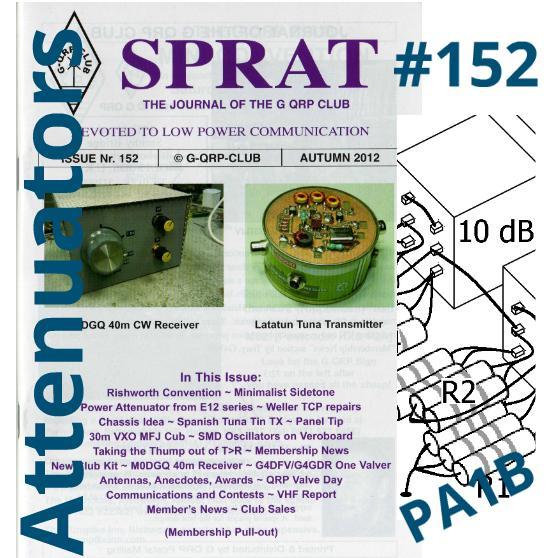
Corrected Layout of the Power Attenuators in Sprat

Click to enlarge
Sprat 152 features the article:
Power Attenuators with carbon resistors from the E12-series,
by Bert PA1B


I spent a lot of time and enjoyed making the drawing of the layout for this article in Sprat. 
But unfortunately the drawing of the layout published is Sprat 152, is  NOT correct. 

Please use this Corrected Layout to build your attenuators.

In the drawing of the layout the resistor R2 should be connected to R1 and R3. The resistor R5 should be conected to R4 and R6.
The arrows point to the right connections.


Markus DL6YYM found the info on the attenuators for 5 watts on the PA1B QRPp page and sent his questions by e-mail. In this e-mail exchange, I sent the schematic and the drawing of the layout of the 10 dB and 20 dB attenuators, that were published in Sprat 152. Markus discovered that the published layout is not correct, while he was building the attenuator. So here is the Corrected Layout. So I thank Markus, for his attentiveness. 

I already sent the corrected layout to George G3RJV and he replied, that the layout will be in the next issue.

Good luck in QRPp.


zondag 14 oktober 2012

SPRAT 152 arrived

A few days ago Sprat arrived. I was eagerly awaiting the new Sprat. This new SPRAT 152 would contain an article, that I wrote about easy to build Power Attenuators with resistors from the E12-series.

I expected the SPRAT to arrive last week. But when it did not arrive in the following week, I was surprised. Then I went to the interesting Blog of Roger G3XBM, to see whether he already received his copy and writes about it. NO. Then I sent a mail to Roger. YES. Roger did receive Sprat, last week and wrote that he enjoyed the article. Tnx Roger.

I hope you all enjoy the article and have success and lots of FUN with you new build attenuators.
When the S-meter goes up, the power goes down. 

Not received SPRAT?
A quick search brought my to the GQRP club members new page with the following message at the bottom of the page:

Sprat 152 - 28/9/2012 - From G4WIF
The latest Issue 152 is now beginning to arrive but will probably not be complete worldwide until well into mid/late October. Please don't contact me if yours hasn't arrived until the end of the 3rd week of October. Please also don't assume that as your friend in the same town has their Sprat that yours must have got lost - as bulk mail can be unpredictable.

So I had to be pacient. hi

zaterdag 4 augustus 2012

Attenuators and tuning

50 Ohm attenuators
The attenuators shown on the PA1B Attenuator page are all very accurate 50 ohm attenuators. The accuracy is obtained by placing two, or more,  resistors in parallel, to form the required ohmic values very accurately, with resistors from the E12-series.
But the accuracy of the attenuators is also dependent on the termination of the attenuators. 
When the attenuator is terminated with 50 ohms, the attenuator will show also an input impedance of 50 ohms and most important, will give the right attenuation.

Setup
The attenuator will be placed behind the set. The SWR-meter is not shown in the drawing, but is placed between the attenuator and the tuner (transmatch). I work with this setup, as long as I work with the attenuators and by doing so, I made many fine QRPpp QSO's, using an inverted Vee as antenna.

The right setup.        Tune, as accurate as possible, for a SWR of 1:1,
Tuning
Tuning is done with the attenuator on bypass (0 dB). Tune carefully to get a SWR of exactly 1 : 1. When the SWR is 1:1, the input of the tuner will show an impedance of 50 ohms, so later with the attenuator switched on, the attenuator is terminated with 50 ohms and the attenuator will give the right attenuation. It's very important to tune for 1:1 as accurate as you can, to get a termination with 50 ohms for the attenuator.

SWR
I got an e-mail from a follow Blogger, Mike VE3WDM. He was using the autotuner of the Elecraft K3. The K3 is connected to  the SWR-meter, which is connected to the attenuator, which is connected to coax to the antenna. Mike wrote that he had a SWR of 1.6 : 1, with the attenuator on by-pass. Since the autotuner is in the set and the SWR-meter is behind the set, this means that the coax to Mike's attic antenna shows an impedance of 31.25 ohms or 80 ohms. (50/1.6 or 50x1.6)
The e-mail of Mike made me realize, it is not possible to use the autotuner in the set, together with the attenuators. The tuner has to be behind the attenuator. However, it is always possible to use another (homebrew) tuner behind the attenuators. Mike later said that he will place a tuner behind the attenuators and will turn off the tuner in the set . 

So place the tuner behind the attenuator and tune as accurate as you can to get a SWR of 1 : 1, to get the right attenuation. 

dinsdag 26 april 2011

Attenuator of 20 dB to WSPR with 10 mW

QRSS and QRPp is an excellent combination.
The reduction in speed, can be translated directly into a reduction in power.
So if you are bored with 1 watt, then try this simple attenuator, which is built with good available E12-series resistors.


The input power of the attenuator is 1 watt, if the maximum power dissipation of each resistor is 1/2 watt.

This attenuator can be used to WSPR with very low power.
With the FT-817 on 1 watt, the power is reduced to 10 mW.
And with 500 mW the power of the FT-817 is reduced to 5 mW.
The difference between 10 mW and 5 mW will not be noticed, except if you look carefully at the remote S-meter of the receiving WSPR station.

7 Resistors and a switch is all you need for WSPR with QRPp with 10 mW. hi
But notice that the attenuator is also giving 20 dB attenuation while receiving.

vrijdag 1 april 2011

Power Attenuator Calculator

Yesterday I made additions and changes to the Power Attenuator Calculator.
This spreadsheet, can be used to design Power Attenuators.

With this excellent Power Attenuator Calculator you can design attenuators of 3 dB, 10 dB or 20 dB, for any Input Power you want, which are built with good available resistors of the E12-series, with a maximum power that you can chose yourself.

I use attenuators for QSO's with very low power.
A 10 dB attenuator reduces the 500 mW from my FT-817 to 50 mW.

The new Calculator will show up later on the PA1B QRPp page, but via the Public link to Dropbox Power Attenuator Calculator you can download the calculator in advance.
Take a look and get your self a shopping list for an attenuator.

Bert PA1B