Just for fun I entered the CQ WW WPX contest. I was getting enthusiast for this phone contest by my fellow bloggers who work with phone most of the time. This is the second time that I participate in a contest in phone.
As a QRPp enthusiast I participated in many contests in CW using the lowest possible power.
Even when I prepared for the contest, I noticed that I only had worked CW in the past.
I had to program VFOb of the FT-817 for the SSB segments of the 40 m, 20 m and 15 m band.
Further I had to search for the microphone. hi
I tune with the MorseMachine and the set switched to CW and then I have to switch back to phone before I can use the microphone. When I forget I don't have any power. So I use an extra power meter behind the set, to monitor my power. hi
I started on 15 m. My power is 2.7 watts and the antenna is an Inverted Vee.
After 6 QSO we went shopping.
I was very curious how it would go in this phone contest. But now I found out, that just as with CW with very low power, the signals in phone also have to be S9 or better.
At the moment there are already 38 QSO's in the log. Not bad at all. hi
zondag 31 maart 2013

zondag 24 maart 2013
eQSL from Chili
Recently I received an eQSL from Nicolas XQ1KZ from Chili for a more than 1000 MPW QSO.
We made the QSO in the CQ MM DX contest in 2012.
The distance is 6910 Miles. With 2.7 Watts this gives 2559 Miles per Watt.
 I used an Inverted Vee.
Thanks to Nicolas XQ1KZ for a new DXCC in QRP.
We made the QSO in the CQ MM DX contest in 2012.
The distance is 6910 Miles. With 2.7 Watts this gives 2559 Miles per Watt.

Thanks to Nicolas XQ1KZ for a new DXCC in QRP.
zondag 17 maart 2013
Info on my 1000 Miles per Watt QSL card
Last week I wrote a small pile of 60 QSL cards. Almost all of the cards were for QSO's with more than 1000 Miles per Watt. The used power in the QSO's was 2.7 Watts down to 1.8 milliwatt.
While I was writing the cards, I took up the plan to take a photograph of one of the many "more than 1000 Miles per Watt QSL cards" that I was writing, just to show how I present the "1000 MPW info" on my a card.
Photo
Actually I was going to photograph the QSL card, that I would send to LZ6C for a QSO with 1.8 mW. For this QSO I calculated 559091 Miles per Watt.
But when I just looked on the camera, it turned out to be that I took a picture of an other card for a QSO with LZ6C, that was made with 36 mW. I can not take a new picture, since both cards are already on their way to the Radio Club Silpa. hi
1000 MPW info
At the top of the card I give the power catatgory: QRP, QRPp or QRPpp.
QRPpp is the (not official) term, that I use for a power of less than 100 mW. hi
The FT-817 can be adjusted to 5 W, 2.5 W, 1 W or 500 mW, so I encircle the used power.
Well, after a serious mismatch the power of my FT-817 is 360 mW when adjusted to 500 mW, so I write 360 mW above the FT-817.
Since I used the 10 dB attenuator, I encircled the value 10 dB in the attenuator.
The most important value is the power to the antenna. Here 36 milliwatts.
My locator is JO22na. The locator of LZ6C is KN13ot.
Using both the locators, I calculated the distance and the Miles per Watt, with the excellent (Click) N9SSA Distance and MPW Calculator.
The distance is 1006 Miles and 27955 Miles per Watt.
Thanks to the Radio Club Silpa with their Excellent Ears.
While I was writing the cards, I took up the plan to take a photograph of one of the many "more than 1000 Miles per Watt QSL cards" that I was writing, just to show how I present the "1000 MPW info" on my a card.
Photo
Actually I was going to photograph the QSL card, that I would send to LZ6C for a QSO with 1.8 mW. For this QSO I calculated 559091 Miles per Watt.
But when I just looked on the camera, it turned out to be that I took a picture of an other card for a QSO with LZ6C, that was made with 36 mW. I can not take a new picture, since both cards are already on their way to the Radio Club Silpa. hi
 |
| Please click to see all the interesting details for 1000 Miles per Watt |
At the top of the card I give the power catatgory: QRP, QRPp or QRPpp.
QRPpp is the (not official) term, that I use for a power of less than 100 mW. hi
The FT-817 can be adjusted to 5 W, 2.5 W, 1 W or 500 mW, so I encircle the used power.
Well, after a serious mismatch the power of my FT-817 is 360 mW when adjusted to 500 mW, so I write 360 mW above the FT-817.
Since I used the 10 dB attenuator, I encircled the value 10 dB in the attenuator.
The most important value is the power to the antenna. Here 36 milliwatts.
My locator is JO22na. The locator of LZ6C is KN13ot.
Using both the locators, I calculated the distance and the Miles per Watt, with the excellent (Click) N9SSA Distance and MPW Calculator.
The distance is 1006 Miles and 27955 Miles per Watt.
Thanks to the Radio Club Silpa with their Excellent Ears.
zaterdag 16 maart 2013
WSPR with 1 milliwatt
 Go to the WSPR Database to see what is possible with very low power with WSPR.
First choose the band of interest.
Then select sort by: Power
Reverse the order to find the low power spots.
You can see more than 50 spots. Maximum number of spots is 20000. hi.
The lowest power value that can be uploaded to the Weak Signal Propagation Reporter Network
is 1 milliwatt, which is 0 dBm.
Please ignore all the spots with less than 1 mW.
Results with 1 milliwatt
The table below shows spots for 1 mW. (+0 dBm) The short table below shows spots that were made with the 1 milliwatt. The signals have traveled a considerable distance.
In this table all the received signals are "solid copy", since all the signals are received with a SNR of -29 dB or more. The higher the SNR, the stronger the signal.
In one of the spots Joe, K1JT is received with a SNR of +11 dB. (Horizontal arrow)
This is 40 dB above the threshold for solid copy in WSPR of -29 dB. The signal could still be received if Joe had used a 40 dB lower power. Thus with 0.1 microWatt. hi
For more info on this calculation, please click on: Calculated lowest possible power in a WSPR spot.

WSPR with 1 milliwatt can be compared with CW with 12 to 30 milliwatt
or SSB with 100 to 400 milliwatt.
zondag 10 maart 2013
Landgoed Oostbroek - Knuppelpad


We hadden de kleindochters te logeren.
Vanmorgen wilden ze het knuppelpad lopen op het landgoed Oostbroek. Op weg er naar toe, viel het niet eens op dat het licht gesneeuw had. Maar het was prachtig met de sneeuw.
Al vonden ze het wel heel koud.

dinsdag 5 maart 2013
Black Sea Cup International
The Black Sea Cup International is nice contest that is organized by the BSCC.
In just two hours I made 25 QSO's with the lowest possible power.

SOAPBOX: In all QSO's, I used the lowest possible power, with
search and pounce.
SOAPBOX: Power used 2.7 W down to 18 mW. Antenna: Inverted Vee
SOAPBOX: Used an attenuator for very low power. Hi.
SOAPBOX: Thank you for the activity in the contest.
Band QSOs Dupes Points Mults
20 23 0 202 19
15 2 0 10 2
=========================================
Total 25 0 212 21
Claimed score is 4452 points
zondag 3 maart 2013
SSB vs WSPR
In various publications, the difference between SSB and CW, is given as 13 dB.
The difference in power between CW and WSPR is 13 dB. (Click)
Or somewhere between 15 dB and 11 dB.
So when I take a figure of 13 dB for both values above, I estimate that the
difference between SSB and WSPR is 13 + 13 = 26 dB or 20 x 20 = 400 in power.
So 400 W in SSB can be compared with 1 W in WSPR.
WSPR - CW - SSB
For an advantage of 26 dB, the power in WSPR can be 1/400th of the power in SSB or 1/20th of the power in CW. This means that the power in WSPR, must be much lower, than the power used in SSB.
If you use a speech processor, you can use a lower value than 26 dB. E.g. 22 dB.
So you can use WSPR for a propagation analysis, to see what is possible with your SSB station.
How to use WSPR to see what's possible with SSB
A power of 80 Watts in SSB or 4 W in CW, can be compared with a power of 200 mW in WSPR.
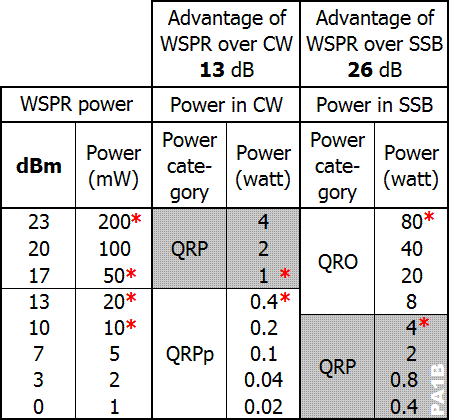
As a CW enthusiast you can use WSPR spots made with 20 mW or 50 mW to analyse with WSPR where your CW signal of 400 mW to 1 Watt can be heard.
vrijdag 1 maart 2013
ARRL internationl DX CW 2013
 Looking back, after nearly two weeks, I am still confused by the great results.
I made much more QSO's, than I expected. I worked much more states.
Morse Machine
Morse Machine
I had programmed the Morse Machine for two different reports.
For QRP: 599 003 003 for QSO's with 2.7 Watts and 599 001 001 for QSO's with 800 mW or less.
Further I programmed a button to give my power instandly, 3W 3W, if any one should ask my power.
 |
| Click to see the States |
I did not start early.
I first went to 21 MHz and answered 8 CQ's
per hour for 3 1/2 hour.
I started on 21 MHz because on 14 MHz
there was more activity, but on 21 MHz
it was more relaxed.
After 3 1/2 hours I had 30 QSO's in the Log.
Not bad. Since I hoped to make between
60 and 90 QSO's. hi
Then I went to 14 MHz and the speed increased
to 12 QSO's per hour.
So at the end of the evening I had 83 QSO's in the Log. WOW
On Sunday I first made some QSO's on 21 MHz.
At the right moment to 28 MHz
When I went to 28 MHz, there were not that many stations on the band.
The longer I stayed on the band the more stations also came on the band,
so I continuously met stations, that I had worked before on 14 and 21 MHz.
At first with 12 QSO's in a hour and later with 16 QSO's per hour.
When 28 MHz closed there were about 150 QSO's logged.
After some more QSO's on 14 MHz and 21 MHz, the final number of QSO's is 162.
QRPp
In 9 QSO's I used 800 mW and in 7 QSO's I used 360 mW.
For these QSO's, I gave an exchange 5NN TT1 TT1.
In all most other contests, I use the lowest possible power in each QSO.
But in this contest, I only reduced my power, when the signals were much stronger than usual and only when the station was calling CQ continuously. So I did not make that many QRPp QSO's.
But I am very content with the results
3W FB -and- QRP GL
On many occasions the operator on the other side informed me, that he was aware of the fact that I was using QRP. From a simple CFM TU, to 3W FB or QRP GL. hi
Repeated exchange
The exchange 599 003 can be an confusing experience.
Just for fun I kept note, of the times, that I had to repeat or explain my exchange.
On Saturday I had to repeat in 8 QSO's on 21 MHz and later in only 2 QSO's on 14 MHz.
On Sunday I had to repeat my exchange only in 3 QSO's.
Antenna
My antenna is an Inverted Vee for 40 meters. which also works very well on higher frequencies.
I first went to 21 MHz and answered 8 CQ's
per hour for 3 1/2 hour.
I started on 21 MHz because on 14 MHz
there was more activity, but on 21 MHz
it was more relaxed.
After 3 1/2 hours I had 30 QSO's in the Log.
Not bad. Since I hoped to make between
60 and 90 QSO's. hi
Then I went to 14 MHz and the speed increased
to 12 QSO's per hour.
So at the end of the evening I had 83 QSO's in the Log. WOW
On Sunday I first made some QSO's on 21 MHz.
At the right moment to 28 MHz
When I went to 28 MHz, there were not that many stations on the band.
The longer I stayed on the band the more stations also came on the band,
so I continuously met stations, that I had worked before on 14 and 21 MHz.
At first with 12 QSO's in a hour and later with 16 QSO's per hour.
When 28 MHz closed there were about 150 QSO's logged.
After some more QSO's on 14 MHz and 21 MHz, the final number of QSO's is 162.
QRP
In 144 QSO I used a power of 2.7 Watts and
gave 5NN TT3 TT3.
I programmed the Morse Machine to give the 003 twice in each QSO.
In 144 QSO I used a power of 2.7 Watts and
gave 5NN TT3 TT3.
I programmed the Morse Machine to give the 003 twice in each QSO.
QRPp
In 9 QSO's I used 800 mW and in 7 QSO's I used 360 mW.
For these QSO's, I gave an exchange 5NN TT1 TT1.
In all most other contests, I use the lowest possible power in each QSO.
But in this contest, I only reduced my power, when the signals were much stronger than usual and only when the station was calling CQ continuously. So I did not make that many QRPp QSO's.
But I am very content with the results
3W FB -and- QRP GL
On many occasions the operator on the other side informed me, that he was aware of the fact that I was using QRP. From a simple CFM TU, to 3W FB or QRP GL. hi
Repeated exchange
The exchange 599 003 can be an confusing experience.
Just for fun I kept note, of the times, that I had to repeat or explain my exchange.
On Saturday I had to repeat in 8 QSO's on 21 MHz and later in only 2 QSO's on 14 MHz.
On Sunday I had to repeat my exchange only in 3 QSO's.
Antenna
My antenna is an Inverted Vee for 40 meters. which also works very well on higher frequencies.
dinsdag 19 februari 2013
PA1B 0 - 36 dB Attenuator for QSO's
Last week, the info on the interesting Attenuator page of my web site was updated.
I added new info on the PA1B 0 - 36 dB Attenuator, specially designed for QSO's (Click)
I also placed new info on the PA1B 0 - 36 dB Attenuator, under the Tab's on the top of this Blog.
A simple way to reduce the power of your QRP transceiver, without modifying the set, is the use of attenuators. This accurate PA1B 0 - 36 dB attenuator, is an excellent attenuator, to use in QSO's with very low power. This attenuator enables you, in contest QSO's, to go to the next setting instandly, when your call is not heard.

The combination 20 dB - 10 dB - 3 dB - 3 dB is very quick to adjust in contest QSO's.
The choice of the values, makes it very easy to calculate the power at the output instantly.
This accurate Power Attenuator is designed for the use in QSO's.
With only 4 switches it is surprisingly fast and easy to operate.

Power Attenuator Calculator
I use the excellent Power Attenuator Calculator (Click), for the
design of the Power Attenuators.
With the Power Attenuator Calculator, you can design an attenuator for any input power.
On my web site: Home - PA1B QRPp page
zondag 17 februari 2013
PACC with QRPp

I found out that calling CQ was to much for my.
After just 3 QSO's, with 360 mW, in just less than 3 minutes, I had to take some rest.
So I decided to work in a relaxed way, with Search and Pounce.
I worked with Search and Pounce from 2.7 watts down to 1.8 milliwatts
When the S-meter goes up, my power goes down.
I frequently alternated S&P and calling CQ, with just 800 milliwatts.
While calling CQ with 800 mW, I made a total of 30 QSO's , in a number of short run's.
In the last 15 minutes of the contest I made a run of 13 QSO's with 2.7 W.
To my surprise, I noticed only a small difference between 800 mW and 2.7 W.
I worked YT6T with 8 mW and LZ6C with only 1.8 mW.
It's a long time since I could make QSO's with less than 5 milliwatts. hi
The signal of LZ6C wasvery strong: S9 plus more than 20 dB.

donderdag 14 februari 2013
REF CW contest 2013
This year I only participated for a total of 45 minutes on Sunday.
 The changes in propagation can be very large.
In a relaxed way, I used search and pounce with the use of the lowest possible power in each QSO.
The conditions were good for the use of low power on 14 MHz.
On 14 MHz all QSO are good for 1000 Miles per Watt.
On 14 MHz all QSO are good for 1000 Miles per Watt.
Despite the short distance to France, 5 out of 6 QSO's are made with QRPpp*.
On 7 MHz I had to use the maximum power of 2.7 watts in most QSO's.
The changes in propagation can be very large.
In the afternoon, I met a station from Corsica, that I had worked earlier with 360 mW.
I tried to make an second QSO with 36 mW. His signal was S9 + 10 dB. He recognized my call and gave QSO B4. I gave a new report. But then we ended up, transmitting at the same time. So.....this QSO will probably not make it into the log. hi
I enjoyed the opportunity to work with very low power in the REF CW contest.
QRPpp* is the (not official) term that I use for a power of less than 100 mW. Bert PA1B QRPpp
I enjoyed the opportunity to work with very low power in the REF CW contest.
QRPpp* is the (not official) term that I use for a power of less than 100 mW. Bert PA1B QRPpp
dinsdag 12 februari 2013
QRPp in the ARRL int DX contest
In my first ARRL international DX contest, I used 5 watts. My exchange 599 005 gave no problem for the receiving station. In CW of course given as: 5NN TT5.
It was obvious, that I was using QRP.
I very much like the ARRL international DX contest. In this contest, the DX stations, like myself, will give their power in the exchange. So the receiving station knows immediately, that I am working with QRP.
In most contest QSO's, I often use the Lowest Possible Power, in each QSO, using S&P.
When I hear a station calling CQ, I look on the S-meter to determine the power with which I will answer.
In later years, I reduced to 500 mW, when the propagation was very good. The use of 500 mW in a contest QSO is no problem, because most of the time, the response will be immediate and correct.
The lowest value for the power in the Cabrillo file is 001.
Over the years, I found out, that when I was using 1 W, it was best. to use the exchange 599 001.
How to indicate, that I am using only 500 mW? Well, that's simple. The DX station give their estimated power. So for a power of less than 1 W, I also give the exchange : 599 001.
But don't think that all problems are gone with 599 001. Some stations keep asking pwr?, because they think that 001 is a number or they respond with 100? or even 1kW?.
In that case I will respond with: 599 1W 1W
* I met operators, that fall out of their chair, when they realized, that my exchange 599 001 indicated, that I was using only 1 watt.
Two seconds of silence and an additional "1W FB", from a station that is transmitting not a letter to many, I consider a huge compliment. hi
Please notice that when you use low power, that any QSO between Canada or the USA with Europe with 3 Watts or less, is good for 1000 Miles per Watt.


It was obvious, that I was using QRP.
I very much like the ARRL international DX contest. In this contest, the DX stations, like myself, will give their power in the exchange. So the receiving station knows immediately, that I am working with QRP.
When the S-meter goes up my power goes down.
In most contest QSO's, I often use the Lowest Possible Power, in each QSO, using S&P.
When I hear a station calling CQ, I look on the S-meter to determine the power with which I will answer.
In later years, I reduced to 500 mW, when the propagation was very good. The use of 500 mW in a contest QSO is no problem, because most of the time, the response will be immediate and correct.
pwr? . . .100? . . . 1kW? . . . . . . . 1W FB
The lowest value for the power in the Cabrillo file is 001.
Over the years, I found out, that when I was using 1 W, it was best. to use the exchange 599 001.
How to indicate, that I am using only 500 mW? Well, that's simple. The DX station give their estimated power. So for a power of less than 1 W, I also give the exchange : 599 001.
But don't think that all problems are gone with 599 001. Some stations keep asking pwr?, because they think that 001 is a number or they respond with 100? or even 1kW?.
In that case I will respond with: 599 1W 1W
* I met operators, that fall out of their chair, when they realized, that my exchange 599 001 indicated, that I was using only 1 watt.
Two seconds of silence and an additional "1W FB", from a station that is transmitting not a letter to many, I consider a huge compliment. hi
Please notice that when you use low power, that any QSO between Canada or the USA with Europe with 3 Watts or less, is good for 1000 Miles per Watt.

Power of the FT-817 at PA1B's, after serious mis-match.
zondag 3 februari 2013
Power with WSPR
 |
| WSPR vs CW 13 dB |
WSPR is a beacon system. The WSPR data can be used to probe radio frequency propagation conditions.
WSPR uses a low transmission speed.
The lower the transmission speed, the lower the power, that is needed.
As you will see: Please WSPR with QRP.
Roger G3XBM asked Joe Tailor K1JT about the difference between "CW by ear" and WSPR.
Roger placed Joe's response in an entry
on his Blog:
WSPR versus CW - what's the improvement
Click to go to the article.
In a description on the WSJT web site, Joe gives a comparison between WSPR and CW by ear.
For "CW by ear" Joe gives a SNR of -18 dB for a very skilled human CW opererator.
Joe gives a value of -29 dB for the SNR for a WSPR signal.
So the difference is 11 dB, but Joe estimates that for most operators, the SNR has to be even 15 dB.

I estimate that the difference between WSPR and "CW by ear" is about 13 dB for contest CW operators and 15 dB for most operators.
For an advantage of 13 dB, a power of 5 Watts in WSPR, can be compared with 100 W in CW.
So the power in WSPR can be 1/20th of the power in CW.
The value of 13 dB is guideline to estimate the power that you should use in WSPR to approach the situation that you use with CW.
For an advantage of 15 dB a power of 5 Watts in WSPR, can be compared with 150 W in CW.
So the power in WSPR can be 1/30th of the power in CW.

Calculating with power, 15 dB corresponds to a factor 30,
13 dB is 20x, and 11 dB is 12.5x
Calculating with voltage, 15 dB corresponds to a factor 5.5,
13 dB is 4.5x and 11 dB is only 3.3x
I made a table below to compare WSPR with "CW by ear".
The table shows the values for 15 dB, 13 dB and 11 dB. So you can choose the value yourself.
Please note that a difference of 2 dB or 4 dB is very small compared to the large daily fluctuations (in dB) caused by the propagation.
If you want to analyse what is possible with QRP in CW, you can use 200 mW (23 dB) with WSPR.
This can be compared with 4 W in CW.
As a low power enthusiast I often use the lowest possible power in CW contest QSO's.
I often use less than 1 W. To analyse the possibilities with 1 W in CW, you should use a
power of 50 mW (17 dB) or less. hi
Please note that WSPR with 100 W can be compared with 3000 W, 2000 W or 1250 W in CW.
So gentleman, please:
Think in dB, and WSPR with QRP. hi.
zaterdag 26 januari 2013
Raspberry Whispers
On the interesting Blog of M0XPD is a very interesting article about WSPR experiments with the RPi.
Read the article: Raspberry Whispers by M0XPD.
I just visited the WSPR data base to collect a list of WSPR spots. And made an Analysis of the WSPR spots that M0XPD made on 30 meter with a power of 200 mW.
The stations that are mentioned in the article Raspberry Whispers have Excellent Ears. (Sensitive receivers) The lower the Calculated Field strenght in the better the propagating or the more sensitive the receiving station.

WSPR Analysis
The distance is given in steps of 100 kilometers.
A distance of 250 to 349 km will show up as 300 km.
PI4THT at a distance of 635 km, is placed in the category 600 km.
To compare spots, that are made with a different power (dBm), I calculate the lowest possible power of each spot, using the SNR and the power (dBm) of the transmitting station.
To compare the spots of stations at a different distance, I calculate the Field strength of each spot. This calculation includes the distance in km. In the table, I chose for microVolt/meter, to get nice values.
For one receiving station, the changes in Field strength follow the changes in the propagation to that station.
The RPi is working well.
Read the article: Raspberry Whispers by M0XPD.
I just visited the WSPR data base to collect a list of WSPR spots. And made an Analysis of the WSPR spots that M0XPD made on 30 meter with a power of 200 mW.
The stations that are mentioned in the article Raspberry Whispers have Excellent Ears. (Sensitive receivers) The lower the Calculated Field strenght in the better the propagating or the more sensitive the receiving station.
WSPR Analysis
The distance is given in steps of 100 kilometers.
A distance of 250 to 349 km will show up as 300 km.
PI4THT at a distance of 635 km, is placed in the category 600 km.
To compare spots, that are made with a different power (dBm), I calculate the lowest possible power of each spot, using the SNR and the power (dBm) of the transmitting station.
To compare the spots of stations at a different distance, I calculate the Field strength of each spot. This calculation includes the distance in km. In the table, I chose for microVolt/meter, to get nice values.
For one receiving station, the changes in Field strength follow the changes in the propagation to that station.
- The lower the Field strength, the better the propagation.
While comparing two receiving stations:
- The lower the Field strength, the more sensitive the station.
The RPi is working well.
donderdag 24 januari 2013
Plas Middelwaard with snow
Yesterday morning my wife and I went for a walk around Plas Middelwaard.
At the last moment I grabbed the camera.
The low temperatures formed intriguing ice structures.
At the last moment I grabbed the camera.
The low temperatures formed intriguing ice structures.


I discovered how I can adjust the camera for a close up. As you can see in the jellyfish that was formed by nature.

Later we visited a fish shop. Here I took the last icy picture.
Abonneren op:
Posts (Atom)