woensdag 16 december 2015

The cylinder dipole of Alex SA5BFZ

Alex SA5BFZ built his version of the cylinder dipole with 500 ml monster cans. Before building this antenna, Alex asked by email  information on several details of the cylinder dipole. With the information Alex was able to build the antenna and operated with good results on 10 m and 17 m.

The cylinder dipole with open cans in detail.   Alex SA5BFZ
In the photo you can see that the dipole is attached to the curtain. The cylinder dipole consists of two cans and a coil. I advised Alex use open cans. So he removed the top and the bottom of the cans.

Hej Bert,
Thanks for the info. I removed the top and bottom of the cans as you suggested.
I did some playing around with the antenna this evening. It tunes beautifully 30 - 10 m. 
I will try it more seriously in the weekend, when I have some daylight available.
If I make one single QSO with the antenna, I will keep it as a trophy. Hi hi.
73, Alex
Cylinder dipole of Alex SA5BFZ 
The dipole is connected to the tuner with a ribbon. Last Sunday Alex had some time to test the dipole.

Hallo Bert,
First tests with cylinder dipole done. On 10 m I made QSO with EF5Y using 2.5 W and EF7X using 0.5 W, both with CW. It was very quiet on 10 m, so I went to 17 m and made a 599 QSO with UE25R using 1 W. This really shows that propagation is everything. A good antenna on the other end helps as well. Hi hi. I include a couple of pictures of my operating spot and the antenna. Very simple setup but a lot of fun!  73 Alex

Hallo Bert,
Yes very fun indeed! I still can't understand how they could hear me. Hi hi.
I will try to send the picture again. If you want to use the pictures and info please go ahead. I'm glad that I can be of help. :)  73 Alex

Beautiful results
Alex managed to make  two QSO's over a large distance to Spain with QRP with the cylinder dipole. The first contact with EF5Y was made over a distance of 1688 miles or 2717 km.
The QSO with EF7X was made with a power of 500 mW over a distance of 1848 Miles and is good for 3696 Miles per Watt.
The QSO with UE25R on 17 m was made over a distance of 785 Miles. This QSO on 17 m shows the cylinder dipole, can be used as a multi band antenna. The band is changed, simply by adjusting the tuner on the band of interest.

It looks like the indoor cylinder dipole, can be useful in situations with antenna restrictions.

Thank you Alex for testing the cylinder dipole, sharing the results and the beautiful pictures.

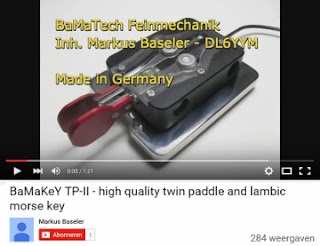
BaMaKeY TP-II - high quality twin paddle and lambic morse key

Markus DL6YYM emailed my, to show his high quality twin paddle key that he produces in his small company. The video gives a good impression of the design and operation of the key.

 Video

The video of the key with all the interesting details, can be found on Youtube;
https://youtu.be/neVx2siF6kM

The technical details and price can be found in this pdf document:
http://www.bamatech.de/dl6yym/BaMaKeY%20TP-II%2006-2015_a.pdf


Designed and built by Markus DL6YYM

Excellent for portable operation
In the shack on the magnetic base

Technical details
Hard anodized aluminum housing,
All brass parts chrome plated,
High precision ball bearings,
Sensitive adjustment of stroke and preload,
Preload adjustable with magnets,
Silvered and golden contacts,
Connecting cable with 3,5mm plug
Weight: 200g / 7,05 oz  -  Dimensions: 0,87x1,97x2,76 (4,33)''

Optional available is a brass chrome plated magnetic base brass chrome plated.
With this magnetic base the portable paddle key can be used as your station paddle key.
Strong magnets hold the travel paddle connected to the base.
Weight: 400g / 14,1 oz  -  Dimensions: 0,31x2,76x3,54''

WOW, Markus. I am impressed. It's a beautiful design.

donderdag 10 december 2015

CQ WW DX CW contest 2015

On Thursday before the contest, a fellow HAM helped my to repair the inverted V. The whether was sunny with no wind, so it was nice to work on the roof. We replaced a part of the 300 ohm ribbon, where it was broken and we checked the connections in the top of the Inverted V.
I decided to repair the inverted V, in stead of using the 15 inch cylinder dipole. The dimensions of the Monster cylinder dipole and it's height 4 m above the ground, allow the antenna work on frequencies of 21 MHz and higher. But now I wanted to use not only 21 MHz, 14 MHz and 7 MHz.

It was great. On Saturday I could make a total of 24 QSO's, all with S&P. The inverted V was working very well. Most QSO's were with European stations on 40 m, 20 m and 15 m. Later I made 4 QSO's with North America. In all the QSO's on Saturday I needed the full power of the FT-817, which is 3,6 W on 20 m and 2,7 W on 40 m and 15 m. That I needed "full power", was only a matter of propagation.

On Sunday morning I immediately noticed that the propagation was better. The signals were stronger than on Saturday. After about 10 QSO's with 2.7 W, the signals became stronger. The S-meter went up, so I could make QSO's with 360 mW. In the first QSO with 36 mW the received signal was S9 + 10 dB. This QSO was a DUPE, but I took my change and really enjoyed that OM7M gave a report, so we made the QSO with QRPpp. I very much enjoy this friendly attitude. 

After this QSO, I came on a quiet part of the 20 m band and I made QSO's all over Europe and two QSO's with North America all with just 360 mW. Then I heard a station from Japan. Luckily it was very quiet on the band (20 m) and with the 3th call, the QSO was made with 3.6 W. I did not dare to go lower. 

The next 30 QSO were made all over Europe, with 360 mW, except when I needed 3,6 W. When the signals incidentally went up to S9 + 10 dB, it was possible to reduce to 36 mW.


It was great. I very much enjoyed to work with the lowest possible power from QSO to QSO on Sunday.

dinsdag 17 november 2015

PA0O with WSPR on 160 m

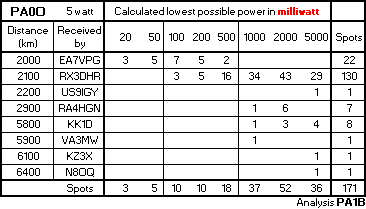
Here is an analysis of very interesting WSPR spots, that were made by Jaap PA0O. The spots were made from the 19th of oktober until the 12th of november 2015. The band was 160 meter. To reduce the length of the table, I only listed the stations that received more than 60 spots.
The strongest signal was received by G8DYK over a distance of 600 km. The longest distance was 6400 km, to N8OQ.

The lower the Calculated lowest possible power, the stronger the signal.
A Calculated lowest possible power of 1 milliwatt, means that a signal with a power of 1 milliwatt, should be received with a SNR of -29 dB. This is a solid copy in WSPR.

Spots over 2000 km or more.
Thanks Jaap for the interesting data.

dinsdag 10 november 2015

SWL eQSL on a DX QSO

I very much like to answer a SWL card, because I know that my card is very much appreciated. In the eQSL Inbox, I found a very nice card, from a SWL station.


DX
Juan  EA4851URE confirms the QSO of PA1B with 6V7S - Op. RK4FF
Juan EA4851URE  -  SWL confirms my QSO that with 6V7S from Senegal, West Africa.
The QSO with 6S7V is made with 2.7 W over a distance of 2852 Miles and is good for 1056 Miles per Watt. hi. Thank you Juan for your beautiful eQSL.


maandag 9 november 2015

SWL R4A-1227 confirms 36 mW QSO

It's great to receive a QSL of a SWL station. In the last batch of eQSL's I found a eQSL from Valentin R4A-1227 that really knocks my socks off. This eQSL is very special, because of the very low power, that I used. I made a QSO with MU0RGU. The signal was very strong, so I decided to answer with 36 mW. The QSO was heard by Valentin R4A-1227.

36 milliwatt
R4A-1227  -  36 mW  -  1734 Miles  -  48,180 Miles per Watt
Miles per Watt
This SWL report and the QSO with M0RGU are both good for more than 1000 Miles per Watt.
PA1B to  R4A-1227  over 1734 miles to LN28gm with 36 mW gives 48180 Miles per Watt.
PA1B to  MU0RGU: over  378 miles with 36 mW gives 10496 Miles per Watt.

Thank you Valentin for the very special eQSL. FB.

zaterdag 7 november 2015

Tuning the cylinder dipole

Cylinder dipole PA1B

In the photo you see the cylinder dipole with open Monster cans. The cans are connected to the coil. I made radial cuts in the top and the bottom of the cans and I bent the points inwards. Later I pushed the white tube, which has a diameter of 40 mm, through the holes. The coil is hanging below the cans and the tube.
This coil has 9 turns on a PVC tube with a diameter of 80 mm. The distance between the cans is equal to the diameter of the cans and is 65 mm. The distance between the cans is not fixed, but can be made smaller by shifting the cans.

Measurement
On both sides of the coil I have attached a single turn, coupling loop. The loops are lightly coupled to the coil. One loop is connected with the RF generator. The other is connected to the oscilloscope.
It's very simple to measure the resonance frequency of the cylinder dipole. By adjusting the frequency, I just peak the signal on the oscilloscope to determine the resonance frequency.

Open cans
In this cylinder dipole I use open cans, because they show less capacity between the closed tops of the cans. This capacity does not contribute to the current on the surface of the cylinders.
The cylinder dipole with the open Monster cans and the 80 mm coil with 9 turn, resonates at 18.9 MHz. This is a higher frequency of the closed monster cans, which resonates at 16 MHz. The capacity of the open can is lower than the capacity of the closed cans and also because the cylinders are further apart.

I use the Cylinder Dipole on 21 MHz and 14 MHz as an indoor antenna in CW contests.

zondag 1 november 2015

Rhijnauwen

1 November startte als een mistige dag. Maar na het ontbijt was het zonnig. We maakte een prachtige wandeling langs de Kromme Rijn bij Rhijnauwen. We hebben genoten.

Langs de Kromme Rijn tegenover het Pannenkoekenhuis
Brug bij Bunnik
Boerderij
Tegenlicht
Bij Rhijnauwen. 

woensdag 28 oktober 2015

Autumn colors

For the last week(s) I very much enjoy the colors of the autumn.
During a bike trip in my village I made a few photo's.
No sun, but I enjoyed the beautiful colors.


vrijdag 16 oktober 2015

eQSL of Mitsuoka JO3JIS

While running through my log, to answer many eQSL's, that I had received, I noticed that I had made a QSO with JO3JIS, but not yet sent a QSL.  I checked and found out that JO3JIS used eQSL, so I send him my card, with the calculated "Miles per Watt" information. I  am very pleased by the quick response, because the next day I received a very nice return eQSL.

JO3JIS   -   2.7 W   -   5400 Miles   -   2110   Miles per Watt
In this QSO I used 2.7 watt. With a distance of 5400 miles, the QSO is good for 2110 Miles per Watt. hi. The distance from my QTH, in the center of The Netherlands, to Japan is more than 5000 miles. So each QSO with Japan made with 5 watts or less, is good for more than 1000 Miles per Watt. My antenna is an Inverted Vee. The antenna of Mitsuoka is a Cushcraft.
Thanks for the very nice DX QSO, Mitsuoka. Hpe cuagn.

maandag 12 oktober 2015

Received eQSL's with very low power

The last weeks I answered a lot of eQSL's.
In the INBOX I found many eQSL of QSO's, that were made with 5 W down to 5 milliwatt.

In many contest QSO's, I often reduce to the lowest possible power.
I start with a power that is probably to low.
When my signal is not heard, I increase my power with a small step.

I show here, a few eQSL's that were made with 36 mW and 80 mW and an Inverted V


36 milliwatt 
F5IN  -  36 mW - 295 miles - 8200 Miles per Watt
F6HKA  -  36 mW - 464 miles - 12886 Miles per Watt

80 milliwatt 
OH2BV  -  80 mW - 953 miles - 19111 Miles per Watt
ES5Q  -  80 mW - 955 miles - 15117 Miles per Watt
R7AB  -  80 mW - 1602 miles - 20020 Miles per Watt
My FT-817 makes 360 mW on the lowest setting.
I reduce 360 mW with an attenuator of 10 dB to 36 mW.
On the setting for 1 W, my FT-817 gives 800 mW.
After the 10 dB attenuator, only 80 mW goes to the inverted V.

zondag 4 oktober 2015

Truckrun


Gisteren ben ik, als begeleider van een bewoner van de Cruquiushoeve, mee geweest met de Truckrun, Dit fantastische evenment wordt georganiseerd door Stichting Het Reservewiel.

Er vertrokken zo'n 80 trucks vanaf het terrein van de Cruquiushoeve in de Haarlemmermeer.

De lange stoet van vrachtwagens maakte al toeterend een rondritdoor de Haarlemmermeer.

Langs het gemaal De Cruquius
Het konvooi van bijna 85 trucks werd begeleid door 30 verkeersregelaars op motoren en een aantal agenten op motoren en in de auto.

De route ging dit jaar van de Cruquius, naar Zwanenburg en Badhoevedorp. Onderweg werd het konvooi opgewacht met een ereboog van water door de de brandweer. We kregen de volle laag van links en van rechts.

Brandweer - links en rechts

Via  Hoofddorp reden we weer terug naar de Cruquiushoeve.

Bij elke zijstraat en zijweg waar maar verkeer uit kon komen, bleef een gemotoriseerde verkeers regelaar achter, om de stoet ongehinderd door te laten gaan. Als alle trucks gepasseerd waren werd de weg weer vrij gegeven.

Verkeers regelaars
Daarna reed de motor weer langs de stoet helemaal naar voren.

We zaten in dit "rolstoel" busje
We hebben met volle teugen genoten.

donderdag 17 september 2015

Jubileumboek BQC

Jubileumboek BQC
1975 - 2015
40 jaar 
Benelux QRP Club

Het was mij begin deze week al opgevallen, dat de Nieuwsbrief van de Benelux QRP club nog binnen was. Vandaag vroeg mijn vrouw: "heb jij wat besteld?", toen ze zag, dat er een pakket in ons kleine buitenbusje zat.

Het pakket bevatte het Jubileumboek BQC en de nieuwe nieuwsbrief van september 2015. Het Jubileumboek bevat vele interessante artikelen uit 40 jaar BQC nieuwsbrief en telt maar liefst meer dan 290 pagina's. De artikelen bestrijken een periode vanaf de oprichting van de BQC tot nu.
Petje af, voor zo'n dik en goed verzorgd boek dat is samengesteld door Ben Santen en is bewerkt door Marc Schijven.

zondag 7 juni 2015

CQ WW WPX CW contest 2015 with an indoor 15" Cylinder dipole

Monster Cylinder Dipole PA1B
I had great fun in 56 QSO's with my
 Mønster  Cylinder Dipole in the CQ WW WPX 2015.  (Click on the picture to enlarge)

The monster antenna consist of  two
 Mønster Energy Drink Cans  
and a coil of 80 mm with 8 turns.
I determined the number of turns of the coil by experimenting.

This very short antenna has a wingspan of 15" or 38cm. "Indoor" results are best if you place the antenna as high as possible.

By making QSO's in a major contest, I could discover the properties of this very short antenna. All QSO's are made with CW and with S&P (Search and Pounce). As a low power enthusiast, I will reduce my power when the received signals get stronger.

On Saturday I worked with the Monster Dipole in  the shack, on a height of 4 meters above the ground. On Sunday morning I placed the antenna in the dormer window in the attic, on a height of 7 meters above the ground. 

Saturday
On Saturday I started on 14 MHz. Between QSO #3 and #4 we went to a fair. After working 6 stations all on 14 MHz, I went to 21 MHz.
The 15 meter band was open, so I made all QSO's on this band from 12 UTC until 19 UTC. From time to time I went back to 14 MHz, but with NO success.  After 19 UTC I could make just one QSO on 20 mtrs. After this QSO an other 16 QSO's were made on 15 m.
After 19 UTC the signal were stronger, so I could reduce my power. I  could make QRPp QSO's with 720 mW, 360 mW and even one QSO with 72 mW.

Miles per Watt
As a low power enthusiast, I reduce my power before answering a CQ, when the S-meter goes up.
It was great fun to make a QSO with 72 mW with YT6A, over a distance of 851 miles.
This QSO is good for 11820 Miles per Watt.
Thanks to Ranko with his sensitive station with Excellent Ears. FB.

Sunday
On Sunday morning I had time until 10 UTC. The first QSO was made with the Island of Man on 7 MHz. To work on 7 MHz I tune the SWR for 1:1. After breakfast I decided to move the Monster Cylinder Dipole to the attic, just to test whether I could make more QSO's on 14 MHz.The test is not conclusive, because I made the same number of QSO's at the same time as on Saturday.
Between 10 and 18 UTC we visited two birthdays. after 18 UTC I made a few QSO's.

Does it work?
The Cylinder Dipole definitely works.
Because I had limited time on Sunday afternoon, I can not tell whether the antenna works better on the attic on 14 MHz. But I can tell you that it works.

In the interesting table below I show the QSO's from hour to hour.
Please notice the peak in the propagation on Saterday from 19-21 UTC.
I worked 7 stations with  360 mW. But that was not all.
The QSO with 72 mW is years later, still the QSO with the lowest power on the Monster Dipole. Hi.

I am very pleased with results of the Monster Dipole.

CQ WPX CW 2015 with an indoor 15" Cylinder dipole PA1B

When did you make QRP QSO's with 20 DXCC counties on a indoor antenna with a wingspan of 38 cm or 15 inch? Hi.
Worked DXCC's in the CQ WPX CW 2015 with an indoor 15" Cylinder dipole PA1B

Solar Eclipse WPA of WSPR spots by PE4BAS

Solar Eclipse WSPR Propagation Analysis (WPA) of spots by PE4BAS.
The spots were made on 160 mtr, during daylight hours.
The lower the Lowest Possible Power, the better the propagation.